
Soft tissue atrophy is a known complication of corticosteroid (steroid) injections, especially when they’re placed superficially or repeatedly in the same area.
What it is:
It’s a localized loss or thinning of subcutaneous fat and sometimes skin, leading to a visible depression or “dent” at the injection site.
Why it happens:
Corticosteroids can:
- Inhibit fibroblast activity ? less collagen production
- Promote fat cell (adipocyte) breakdown
- Cause local vasoconstriction ? reduced tissue support
Clinical features:
- Noticeable indentation or hollowing of the skin
- Skin may appear thinner, lighter (hypopigmented), or slightly shiny
- Usually develops weeks to months after the injection
Risk factors:
- Superficial injection (not deep enough)
- High-potency steroids (e.g., triamcinolone)
- Repeated injections in the same location
- Thin patients / low subcutaneous fat
- Small anatomical areas
Natural course:
- Often partially or fully resolves over 6–18 months
- Some cases may be permanent, especially if severe
Management options:
- Observation (many improve over time)
- Saline injections (thought to help resuspend/flush out steroid crystals)
- Fat grafting (structural correction for persistent defects)
- Dermal fillers (temporary improvement)
Case Example
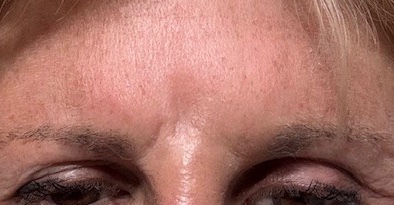
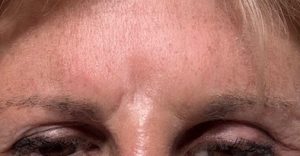 This female presented with a deep asymmetric glabellar soft tissue defect after prior steroid injections. She had a single injection session of Kenalog 20 to treat a persistent fullness in the glabellasr region after a rhinoplasty. Weeks later the soft tissue depression appeared and progressed into a deep depression which never resolved even after six months.
While fat grafting was determined to be a corrective treatment an injection approach to the glabella was not recommended due to the well known risks of vascular occlusion in this low central forehead area.
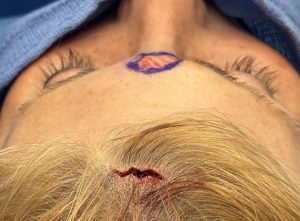
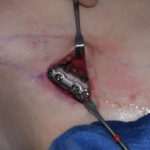
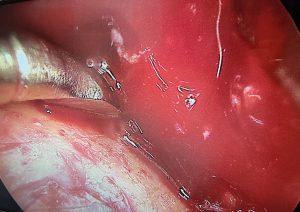 Through a small scalp incision just behind the frontal hairline the glabellar defect was released from the bone using an endoscopic technique.
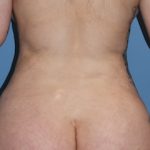
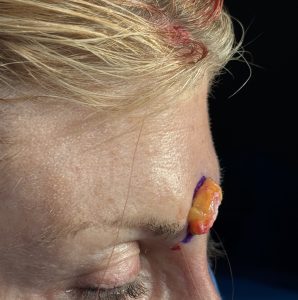 A small dermal-fat graft was harvested from the abdomen and shape to fit the size of the defect . Using a suture technique to pull the graft into the released soft tissue site it was then held into position by an external bolster technique using the pull through dissolvable suture.
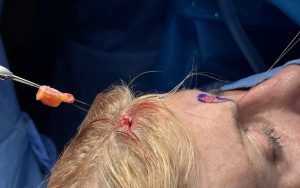
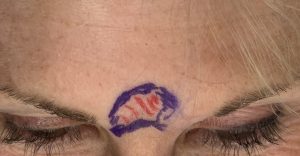
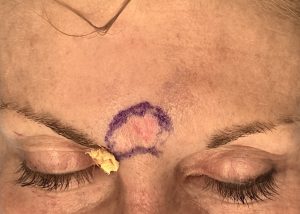 The immediate effect of the graft placement eliminated the glabellar defect. Time will tell how well the graft contour into the tissues as it heals.
Discussion
For steroid-induced soft tissue atrophy that does not resolve in 3 to 6 months fat grafting is the definitive treatment.
Fat grafting
- Provides adipose-derived stem cells + stromal vascular fraction
- Improves:
- dermal thickness
- vascularity
- pigmentation (important for hypopigmented steroid lesions)
- Demonstrated improvement in atrophy + hypopigmentation simultaneously
- Integrates as living tissue ? most natural long-term contour
There are two types of fat grafting options, one well known (fat injections) and the other less well known (dermal-fat grafts)
In essence they differ by:
- Fat injection (lipoaspirate / microfat / nanofat)
vs - Dermal-fat grafts (en bloc composite grafts)
Core difference
- Fat injection = injectable, dispersed, relies on revascularization of small parcels
- Dermal-fat graft = solid graft with dermis + fat, survives partly by plasmatic imbibition ? revascularization
1. Indications (this is where they really diverge)
Fat injections
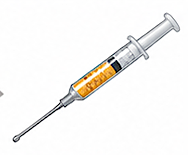
Best for:
- Diffuse or irregular atrophy
- Mild ? moderate volume loss
- Areas needing blending and contour smoothing
- Skin quality improvement (nanofat component)
Dermal-fat grafts
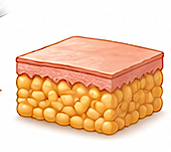
Best for:
- Well-defined, deeper defects
- Severe focal depressions
- Areas with significant fibrosis/tethering
- When you need structural bulk + resistance to contraction
? In steroid atrophy:
- Fat injection = first-line in most cases
- Dermal-fat graft = salvage or severe contour deformity
2. Volume retention & predictability
Fat injections
- Variable take: ~50–80%
- Dependent on:
- technique (microparcel size)
- recipient vascularity (often compromised in steroid atrophy)
- May require staging
Dermal-fat grafts
- More structurally stable
- Less early resorption (especially dermal component)
- But:
- can undergo central fat resorption
- may leave a firmer residual mass
? Practical takeaway:
- Fat = biologically elegant but less predictable
- Dermal-fat = more mechanically reliable bulk
3. Skin effects (critical in steroid atrophy)
Fat injections
- Improves:
- dermal thickness
- vascularity
- pigmentation (via SVF/ADSCs)
- Especially with:
- nanofat or emulsified fat
Dermal-fat grafts
- Dermis provides:
- structural support under thin skin
- Has regenerative effect due to fat-derived stem cells
4. Contour & feel
Fat injections
- Soft, natural
- Excellent for feathering edges
- Low risk of palpability if done well
Dermal-fat grafts
- Can be:
- firmer
- more palpable
- Risk of:
- visible edges
- contour irregularity
5. Technical considerations
Fat injections
- Minimally invasive
- Performed through small cannulas
- Can layer in multiple planes
- Repeatable
Dermal-fat grafts
- Requires:
- open placement
- precise pocket creation
- Donor site:
- scar (often gluteal crease, groin)
- More technically demanding to contour correctly
6. Complications
Fat injections
- Resorption / need for repeat
- Oil cysts (rare with good technique)
- Over/undercorrection
Dermal-fat grafts
- Partial graft loss
- Firmness / nodularity
- Contour mismatch
- Donor site morbidity
7. Where each shines (real-world surgical thinking)
Choose FAT INJECTION when:
- Defect is:
- shallow to moderate
- ill-defined
- Skin is:
- thin, hypopigmented, or damaged
- You want:
- regeneration + contour
- You’re okay with:
- possible staging
? This is most steroid atrophy cases
Choose DERMAL-FAT GRAFT when:
- Defect is:
- deep, discrete, crater-like, small in size
- There is:
- significant fibrosis or tethering
- Prior fat grafting failed
- You need:
- one-time structural fill
- Facial area where injections are risky for vascular occlusion (e.g., glabella)
Bottom line
- Fat injection = biologically active, contour-friendly, first-line
- Dermal-fat graft = structural, discrete deep defects,
Dr Barry Eppley
Plastic Surgeon