
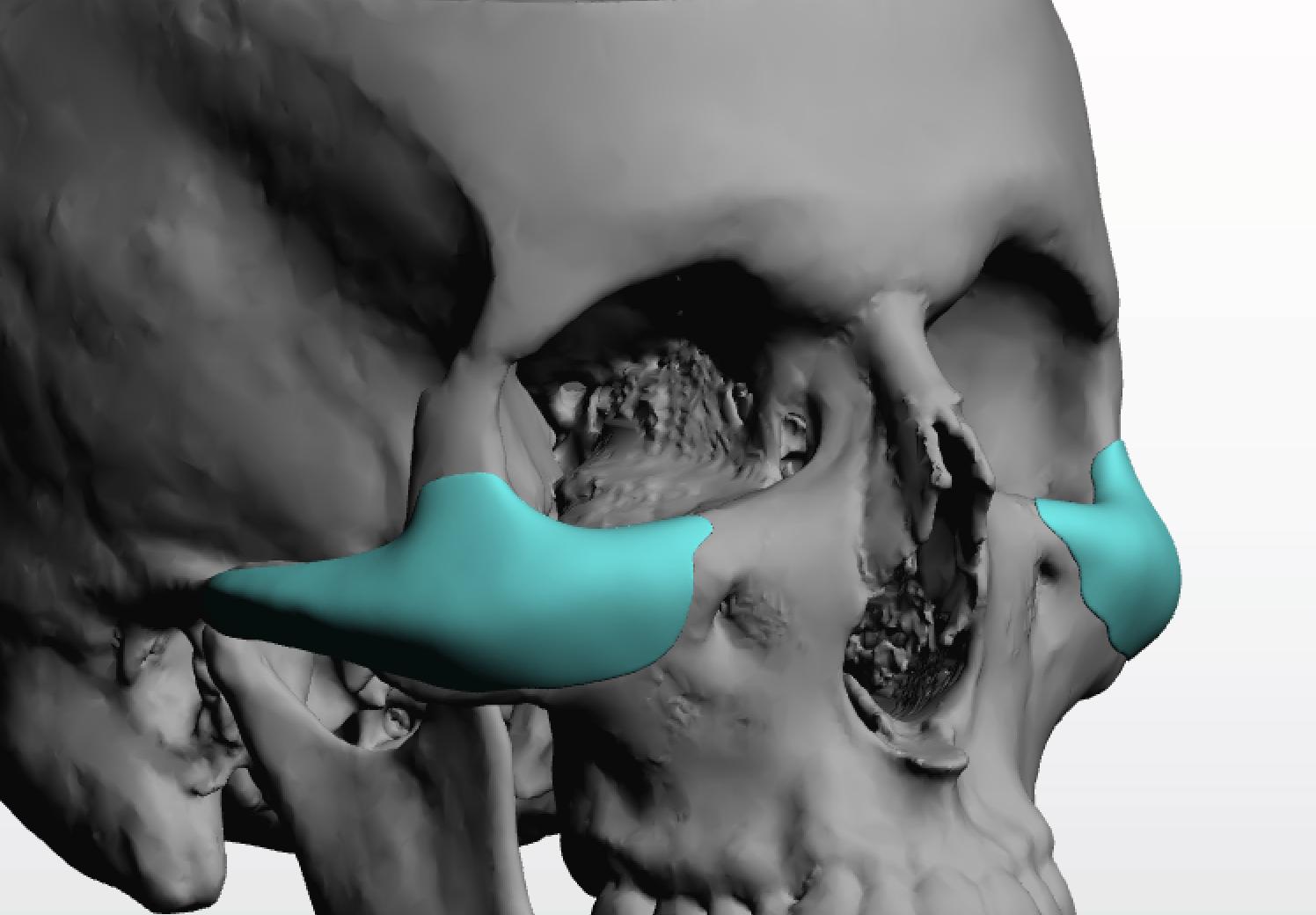
 The midface, and the cheeks in particular, are a common location for the use of custom facial implants designs tom achieve aesthetic results not obtainable with standard implants. For custom cheek (malar/midface) implants, the probability of hitting your exact aesthetic goal is generally a bit higher than jawline implants—but still not perfectly predictable.
Here’s a realistic breakdown:
Probability for custom cheek implants
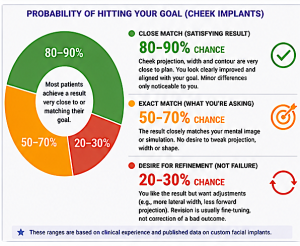
Close match (most people’s outcome)
~80–90% chance
- Improved cheek projection, contour, and facial balance
- Result looks clearly aligned with your goal
- Small differences only noticeable to you
Exact match (your question)
~50–70% chance
- The result closely matches your mental image or simulation
- No desire to tweak projection, width, or shape
? Slightly higher than jawline because cheeks are more localized and easier to control.
Desire for refinement
~20–30% chance
- You like the result but want adjustments (e.g., more lateral width, less anterior projection)
- Revision usually = fine-tuning, not correction of a bad outcome
Why cheeks are more predictable than jawline
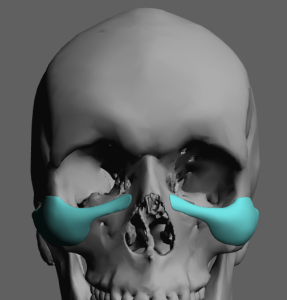
1. Smaller, more localized structure
- Cheek implants affect a compact area (malar eminence)
- Less “cumulative error” compared to the long jawline
2. Softer aesthetic transitions
- Cheek changes blend gradually into surrounding tissue
- Small inaccuracies are less visually obvious
3. Easier symmetry control
- Left/right cheek positioning is simpler than balancing an entire jawline
But still not perfectly predictable
Soft tissue still matters (same limitation)
- Thick midface tissue ? softer, less defined look
- Thin tissue ? sharper, more sculpted
“Vector” matters more than people realize
Cheek implants aren’t just “bigger or smaller”—they involve direction:
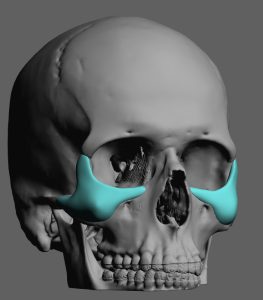
- Anterior (forward) – more projection
- Lateral (sideways) – wider face
- Vertical (under-eye support) – more youthful look
If the vector isn’t exactly right, the result can feel “off” even if technically accurate.
Swelling affects perception
- Cheeks swell noticeably
- Final definition takes 3–6 months (sometimes longer)
Simple comparison (jawline vs cheeks)
|
Outcome |
Jawline |
Cheeks |
|
Exact match |
~40–60% |
~50–70% |
|
Close match |
~75–90% |
~80–90% |
|
Refinement |
~25–35% |
~20–30% |
What pushes you toward the higher end (~70%)
- Very clear goal (e.g., “more lateral width, not forward projection”)
- Using 3D design previews carefully (not blindly trusting them)
- Surgeon experienced in midface aesthetics, not just implant placement
- Matching implant vector to your facial type (this is huge for cheeks)
Important Distinction
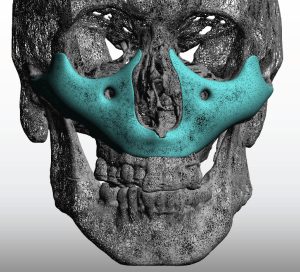
• The term Cheek Implant refers to midface augmentation over the convex bones of the upper midface
• Cheek implant designs may incorporate the lower midface over the concave maxilla
• Soft tissues thicknesses differ over the convex/concave bone surfaces, impacting predictability
Bottom line
- Cheek implants are more predictable than jawline implants
- You have about a 50–70% chance of hitting your exact goal
- And a very high chance (~80–90%) of getting a result you’re happy with
Dr Barry Eppley
Plastic Surgeon