
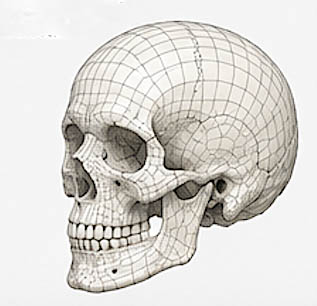
The human skull is not just a collection of bones—it is a highly engineered three-dimensional biological structure designed to achieve four major goals simultaneously:
- Protect the brain
- Support the face
- Enable sensory function
- Provide lightweight structural strength
Its architecture resembles principles seen in:
- domes,
- trusses,
- shell structures,
- and composite materials used in engineering.
1. The Skull as a 3D Structural Shell
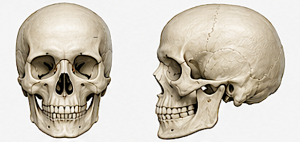
The skull functions as a curved load-bearing shell.
Unlike flat structures, curved shells distribute forces efficiently across their surfaces.
Examples in architecture:
- domes,
- helmets,
- aircraft fuselages.
The skull uses:
- curvature,
- thickness variation,
- and interconnected bone geometry
to resist:
- impact,
- compression,
- torsion,
- and bending forces.
The rounded shape is mechanically superior because force disperses around the surface rather than concentrating at one point.
2. Two Major Architectural Components
The skull is divided into two main structural regions:
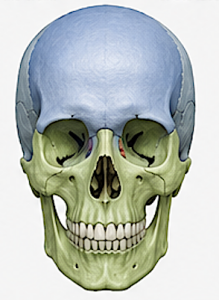
Neurocranium (Cranial Vault)
Protects the brain.
Includes:
- frontal bone
- parietal bones
- temporal bones
- occipital bone
- sphenoid
- ethmoid
This region forms a protective dome.
Viscerocranium (Facial Skeleton)
Supports:
- eyes
- nose
- jaws
- airway
- teeth
Acts more like a complex facial framework suspended beneath the cranial vault.
3. The Cranial Dome
The cranial vault behaves biomechanically like a dome structure.
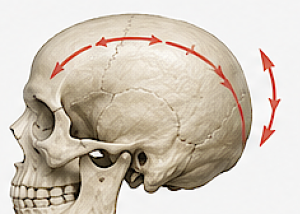
Why domes are strong
Domes convert localized force into distributed stress.
When impact occurs:
- force spreads circumferentially
- stress dissipates across curved surfaces
This prevents catastrophic fracture from small impacts.
The vault is strongest at:
- rounded regions,
- areas with buttressing,
- and thicker bone intersections.
4. Layered Bone Architecture
The skull is a biological sandwich composite.
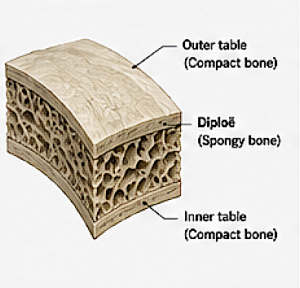
It contains three layers:
Outer Table
Dense cortical bone.
Functions:
- impact resistance
- rigidity
- surface durability
Diploë
Middle cancellous (spongy) bone.
Functions:
- shock absorption
- force dispersion
- weight reduction
Acts similarly to:
- foam-core composite panels.
Inner Table
Thin compact bone adjacent to the brain.
Provides:
- internal structural continuity
- cranial cavity integrity
5. Sutures: Flexible Expansion Joints
Sutures are fibrous joints connecting skull bones.
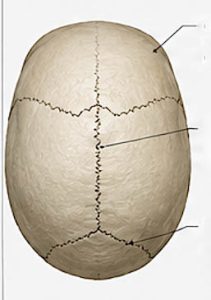
Major sutures include:
- Coronal
- Sagittal
- Lambdoid
- Squamosal
These are not weak seams.
They function like:
- controlled expansion joints,
- energy absorbers,
- growth interfaces.
In infancy they:
- permit brain growth,
- absorb mechanical forces.
Even in adults, sutures help dissipate stress.
6. Buttress Systems of the Face
The facial skeleton is organized into vertical and horizontal buttresses.
These are reinforced structural pillars transmitting force during:
- chewing,
- impact,
- jaw loading.
Vertical Buttresses
Include:
- nasomaxillary
- zygomaticomaxillary
- pterygomaxillary
These transfer forces upward toward the skull base.
Horizontal Buttresses
Include:
- frontal bar
- infraorbital rims
- maxillary arch
These stabilize the face transversely.
This creates a lightweight but strong lattice-like structure.
7. The Skull Base: The Central Load Platform
The skull base is the most geometrically complex region.
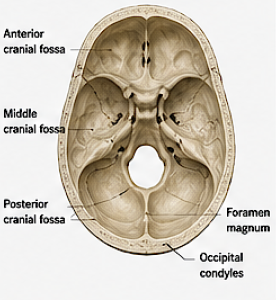
It:
- supports the brain,
- transmits spinal forces,
- houses cranial nerves,
- anchors the facial skeleton.
Unlike the smooth cranial vault, the skull base contains:
- ridges,
- foramina,
- angled planes,
- and dense articulations.
It is essentially the central “foundation platform” of the skull.
8. Three-Dimensional Curvature
The skull is not symmetrical in simple geometric terms.
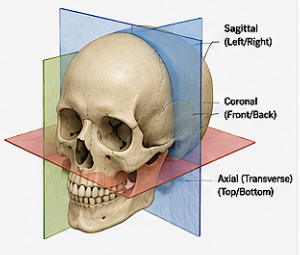
It contains:
- compound curves,
- asymmetries,
- varying radii of curvature.
The curvature changes continuously:
- front to back,
- top to bottom,
- side to side.
These complex curves are critical because they:
- maximize strength,
- optimize volume,
- reduce material mass.
9. Mechanical Force Distribution
The skull constantly experiences forces from:
- mastication
- neck muscles
- gravity
- impact
- facial expression
These forces travel through predictable pathways.
For example:
Chewing forces
Travel:
mandible – maxilla – facial buttresses = cranial base.
Neck muscle forces
Travel:
occiput ? cranial vault ? cervical spine.
The geometry of the skull evolved to handle these repetitive loading patterns efficiently.
10. Openings and Structural Efficiency
The skull contains many openings:
- orbits,
- nasal cavity,
- foramina,
- sinuses.
Normally holes weaken structures.
But the skull compensates using:
- reinforced rims,
- arches,
- buttresses,
- curvature transitions.
This is similar to engineered aerospace structures with reinforced cutouts.
11. Sinuses as Weight-Reduction Chambers
The paranasal sinuses:
- reduce skull weight,
- alter resonance,
- assist thermal regulation.
These air-filled cavities make the skull lighter without dramatically compromising strength.
This is analogous to:
- hollow-core engineering.
12. Developmental 3D Growth
The skull changes shape dramatically during growth.
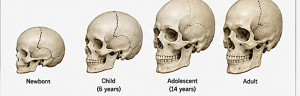
Infant Skull
- Large cranium
- Small face
- Open sutures/fontanelles
- Highly deformable
Adult Skull
- Expanded facial skeleton
- Fused sutures
- Increased bone thickness
- Mature curvature patterns
Growth occurs through:
- sutural expansion,
- bone remodeling,
- mechanical adaptation.
13. The Skull as an Integrated Functional System
The skull is best understood not as separate bones, but as a unified 3D mechanical network.
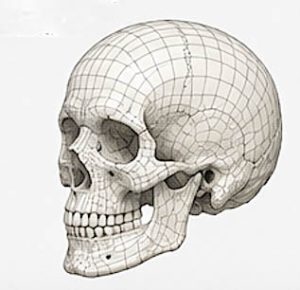
Every region influences others:
- jaw position affects cranial loading,
- cranial shape affects facial projection,
- skull base angle influences facial architecture.
The geometry is deeply interconnected.
14. Architectural Analogy
The skull combines principles of:
|
Engineering Concept |
Skull Equivalent |
|
Dome |
Cranial vault |
|
Truss system |
Facial buttresses |
|
Composite sandwich panel |
Cortical bone + diploë |
|
Expansion joints |
Sutures |
|
Reinforced openings |
Orbital/nasal rims |
|
Lightweight shell |
Overall cranial form |
15. Why the Skull Looks Natural
The skull’s beauty comes from:
- continuous curvature,
- proportional balance,
- smooth transition zones,
- structural harmony.
Its architecture is efficient because evolution optimized:
- strength,
- weight,
- protection,
- and function simultaneously.
It is one of the most sophisticated naturally evolved 3D structures in the human body.Understanding it helps when it comes to any form of aesthetic skull reshaping surgery.
Dr Barry Eppley
Plastic Surgeon