
In adults, a flat back of the head is usually due to one of these situations:
Natural skull shape (flat occiput)
-
- Very common and often genetic/ethnic/anatomical.
- Usually harmless.
- Some people notice it more with short haircuts or certain head angles.
- Residual positional plagiocephaly/brachycephaly from infancy
-
- Flattening that developed as a baby and persisted into adulthood.
- May cause:
- a wider head shape,
- reduced projection at the back,
- asymmetry,
- or difficulty with hats fitting securely
Can it change naturally in adults?
Not significantly. Once skull growth is complete, the bone shape is largely fixed.
Non-surgical options
These do not change the skull bone but can improve appearance:
- hairstyle adjustments,
- posture improvement,
- custom pillows/headrests for comfort only.
Surgical correction options
For adults bothered cosmetically by a flat back of the head an occipital cranioplasty can be performed using either::
- Custom implants (silicone)
- Bone cement augmentation (PMMA/hydroxyapatite)
These surgeries aim to increase projection of the back of the head and create a rounder contour.
Case Example
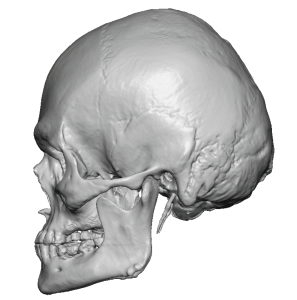 This older male had long been bothered by his flat back of the head. He become very aware of it while in the military when h had a very short haircut. His 3D CT scan showed the high steep occipital angle
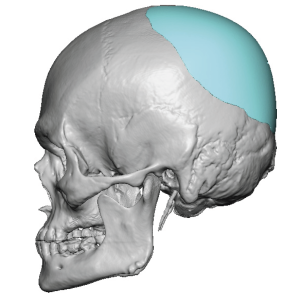 A custom back of the head skull implant was designed with 14mm projection and 100cc volume.
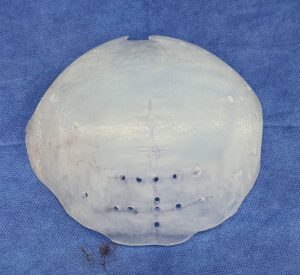
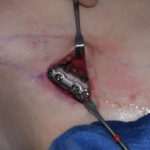
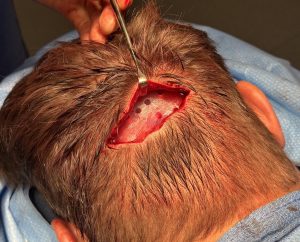 Under general anesthesia and in the prone position the custom skull implant was prepared and placed. The iunplant was prepared by the placement of 4mm holes in the implant for bothalignment and tissue ingrowth purposes.
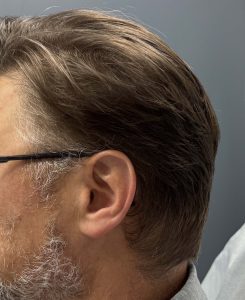
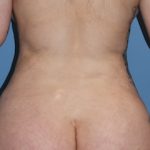
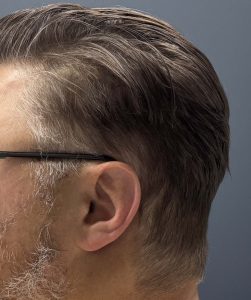 His result seen a few days later shows the augmentation effect.
Discussion
For adult skull augmentation/occipital cranioplasty, the most commonly used implant materials are:
- PMMA (bone cement/acrylic)
- PEEK (polyetheretherketone)
- Silicone
- Hydroxyapatite (HA)
Each has very different characteristics in terms of contouring, feel, infection behavior, imaging, cost, and revision surgery.
PMMA (Polymethylmethacrylate)
Once considered the “workhorse” material in cranial contouring it has largely been replaced by custom implant designs.
Pros:
- Lower cost.
- Long clinical track record.
Cons:
- Exothermic curing reaction if molded intraoperatively.
- Can not be shaped very reliability or smoothly
- Low augmentation volumes
- Difficult to revise
PEEK
A newer custom implant material.
Pros:
- Mechanical properties closer to natural bone.
- Strong but lightweight.
- Excellent custom CAD/CAM accuracy.
- Minimal CT/MRI artifact.
Cons:
- Expensive.
- Limited biologic integration.
- Infection still possible and can require removal.
- Implant edging
- Requires large scalp incision to be placed
Silicone
More common onlay skull augmentation material.
Pros:
- Soft edges and smooth contour.
- Easier revision/removal.
- Can be inserted through small scalp incisions
- Allows for largest implant volumes to be placed
Cons:
- Does not integrate with bone.
Hydroxyapatite (HA)
A calcium-based ceramic similar to bone mineral.
Pros:
- Excellent biocompatibility.
- Bonds well to bone.
- Natural biologic behavior.
Cons:
- Brittle.
- Poor impact resistance
- Requires long scalp incision to be placed shaped
- Difficult to shape as an onlay material
- Low implant volumes
In cosmetic occipital augmentations, and aesthetic skull augmentations in general, custom solid silicone implants are the most widely and successfully used.
- PMMA and HA bone cements have significant shaping and volume limitations
- PMMA is more useful than HA for aesthetic augmentations but good shaping with no edges through limited scalp incisions is difficult
- PEEK as an onlay skull material has issues with edging and requires wide xcalp incisonal exposure for insertion and positioning
Dr. Barry Eppley
Plastic Surgeon