
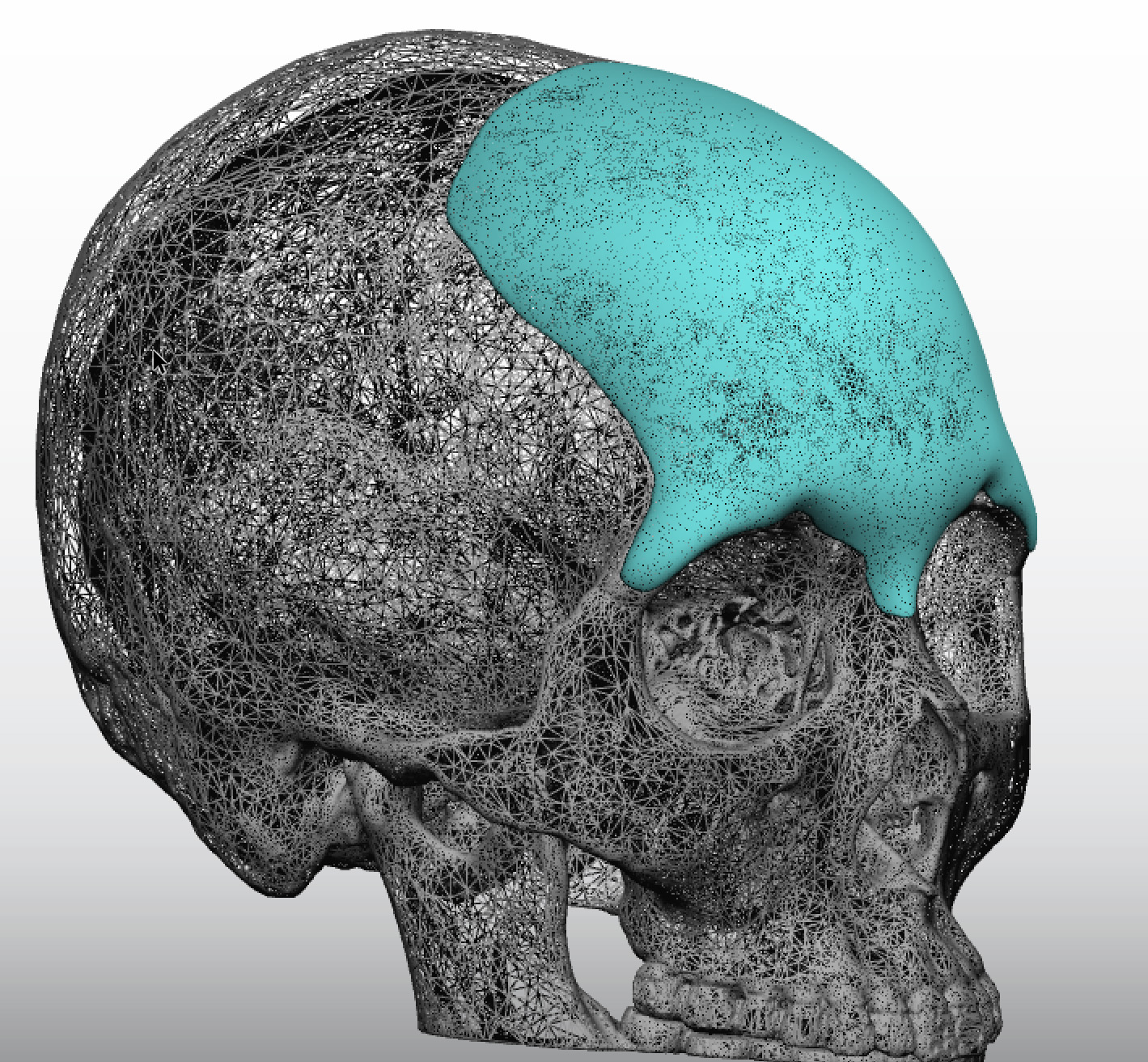
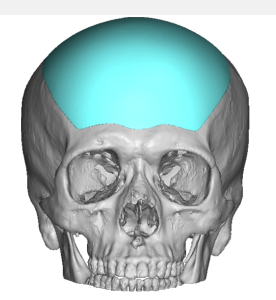
 While custom implants for the upper 1/3 of the face are less common than that of the lower 2/3s they are uniquely different because of their larger sizes. But custom forehead implants are also different because their probability of success profile is actually one of the best among facial implants—both technically and aesthetically in my experience.
Probability for forehead implants
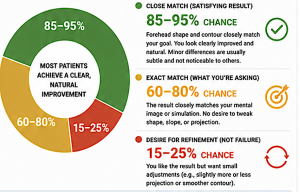
? Close match (most outcomes)
~85–95% chance
- Smoother contour, improved convexity, better brow/forehead harmony
- Result looks very natural and aligned with your goal
- Small differences are usually subtle
Exact match
~60–80% chance
- The result closely matches your mental image or simulation
- No desire to tweak shape, slope, or projection
- Outcome differences are more subtle
This is higher than jawline, cheeks, and orbital areas.
Desire for refinement
~15–25% chance
- You like the result but want small adjustments (e.g., slightly more fullness or smoother transition)
- Revisions are typically minor contour refinements
Why forehead implants are more predictable
1. Large, smooth surface area
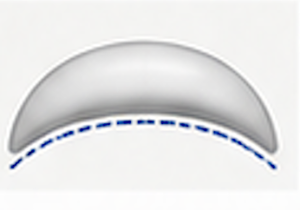

- The forehead is a broad, continuous plane
- Small variations blend in rather than stand out
2. Thick, stable soft tissue coverage
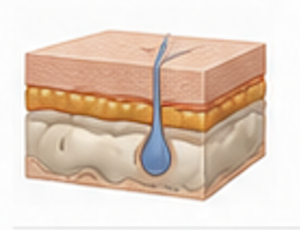
- Forehead skin + soft tissue tends to be more uniform and less mobile than:
- jawline (mobile lower face)
- under-eyes (very delicate)
This reduces unpredictability.
3. Less complex “transition zones”
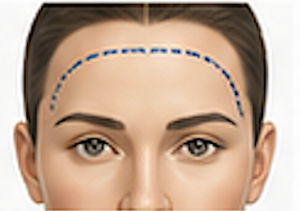
- Unlike orbital or midface, there are fewer critical blend zones
- The main goal is shape + curvature, not micro-contour transitions
4. Swelling has less visual distortion
- Forehead swelling occurs but doesn’t distort perception as dramatically
- Final result becomes clear earlier (~2–4 months typically)
Where mismatch can still happen
Subtle contour perception
- The forehead is judged by:
- light reflection
- curvature smoothness
Even tiny irregularities can be felt subjectively, though often not obvious to others.
Over vs under projection decisions
- Too subtle ? “I wish it was a bit more”
- Too strong ? looks unnatural
Even slight too strong increases the desire for revision
Hairline + brow interaction
- The perceived result depends on:
- hairline position
- brow ridge shape
These can influence whether the result feels “exact” to you.
Comparison across all facial areas
|
Outcome |
Jawline |
Cheeks |
Orbital |
Forehead |
|
Exact match |
~40–60% |
~50–70% |
~45–65% |
~60–80% |
|
Close match |
~75–90% |
~80–90% |
~80–90% |
~85–95% |
|
Refinement |
~25–35% |
~20–30% |
~25–35% |
~15–25% |
What pushes you toward the higher end (~80%)
- Clear goal (e.g., “more convexity vs just bigger”)
- Reviewing side-profile curvature carefully in design
- Surgeon experienced in forehead contouring (not just implants in general)
- Matching implant to your brow + hairline anatomy
- Choosing the right degree of projection (this is the biggest decision)
Bottom line
- Technically: extremely accurate
- Aesthetically: one of the most predictable areas
- Exact goal probability: ~60–80%
- Very high chance (~85–95%) you’ll be clearly satisfied
The key insight:
Forehead implants are less about fine detail and more about getting the overall curvature right—and that’s why they tend to hit closer to the intended result than other facial areas.
Dr Barry Eppley
Plastic Surgeon