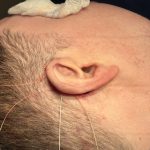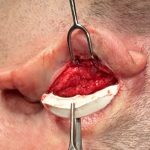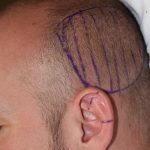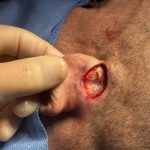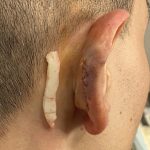
The correction of protruding ears, also known as otoplasty or ear pinning surgery, is a simple plastic surgery procedure that has a dramatic visual effect and an equally significant improvement in one’s self-image. By repositioning the cartilage of the ear with sutures through an incision on the back of the ear, the angle of the ear as it protrudes from the side of the head can be altered to a more favorable setback position. The effect is instantaneous, both on the operative table as well as when the ear dressings come off. Here are my after surgery instructions that I provide to my otoplasty patients.
1. A circumferential head dressing will be placed on at the end of the surgery
to protect the ears in their new position. In adults and teenagers, this dressing
can be removed the next day. In children, the head dressing will stay in place for 1 week.
(if they can stand it for that long!)
2. Dissolvable sutures are used behind the ears so suture removal is not necessary.
3. Once the head dressing is removed, the ears still need to be protected. In
children, a ’ski band’ or head band is to be worn as much as possible for
the next 2 weeks. In adults, this form of protection should be worn only at night
for several weeks after surgery. If one should accidentally twist an ear or roll over
on it during the night, it is possible to loosen or break the sutures with the ear
returning to its appearance prior to surgery.
4. Eyeglasses should not be worn for the first week after surgery so they do not
rub on the incisions behind the ears.
5. The ears will remain somewhat swollen for up to a month after surgery. Be patient
before judging the final result as it takes time for the ears to settle and be less
sensitive to the touch.
6. Swimming and other underwater activities should be avoided for two weeks after
the surgery.
7. Sports activities that pose a risk for direct ear trauma (e.g., basketball) should be
avoided for one month after surgery.
8. Make sure to take and complete your antibiotic prescription. While ear infections are
rare, should they occur around cartilage (known as chondritis), they can pose a
big problem. Cartilage infections are difficult to eliminate.
9. The need for pain medication is usually quite short-lived in otoplasty surgery. The ears
are sore but not acutely painful.
10. The sutures used to reshape the cartilage are permanent. It is uncommon, but possible,
for these sutures years later to extrude on the back of the ear. This usually appears
as a white knot which is easily removed in the office.
Dr. Barry Eppley
http://www.eppleyplasticsurgery.com/
http://www.ologyspa.com/
Clarian North Medical Center, Carmel, Indiana
Clarian West Medical Center, Avon, Indiana
Indianapolis
Haveing spent a long time in plastic surgery at Riley Hospital in Indianapolis, I have performed a lot of cosmetic otoplasties for protrudung ears as well as ear reconstructions in children both with missing or partially missing ears. Parents frequently have a lot of questions about otoplasty in their child and many of these questions are fairly common. Here are the most typical ones.
AT WHAT AGE CAN AN OTOPLASTY BE DONE IN A CHILD?
Classic plastic surgery teaching is that an otoplasty should wait until the ears are nearly fully formed at around age 6. The theory is that scarring on the ear may not cause it to develop properly if done before that age. While this may be classic teaching, it has now been shown that otoplasty done as early age 2 does not result in any problems of ear growth. Therefore, I think age 2 and beyond is a safe time to do otoplasty from an ear development standpoint.
The more relevant question(s) in my mind in terms of otoplasty surgery timing is….when will the child be reasonably cooperative (they need to allow a head dressing to be on for a week after surgery) and when does it bother the child (from a social teasing standpoint). These are practical surgical issues and when these two question are put together, I find age 4 is reasonable. The child at age 4 is more cooperative than age 2 and I think you want to otoplasty surgery BEFORE they are teased to prevent any self-image issues. (i.e., before they formally go to school and are around a lot of other children)
IS RECOVERY AFTER AN OTOPLASTY DIFFICULT?
In general, no. The ears are somewhat tender but not acutely painful. Most bothersome (after 3 or 4 days) is the head dressings which gets itchy and does impede their hearing somewhat (they may have selective hearing anyway!) The head dressing is only there to prevent the ears being bent, twisted, or traumatized which may cause the sutures holding them back to come loose…with the ear ending up sticking out again.
HOW PERMANENT ARE THE RESULTS OF OTOPLASTY?
Once healed, an otoplasty result is fairly permament. Some studieds have shown that very long-term results of otoplasty shown some mild degree of relaxation but the improvememnt is so substantial thaty this minor ‘relapse’ is not even noticed.
Until an otoplasty heals, however, the ear is at risk of coming ‘undone’. For the first month or so, the new ear position is held there by the internal sutures. After that, the scar that forms takes over for the sutures which are no longer needed. Therefore, one must be careful during the first month to not disrupt the internal sutures which are temporarily playing a critical role.
Dr. Barry Eppley
http://www.eplpeyplasticsurgery.com
http://www.ologyspa.com
Clarian North Medical Center, Carmel, Indiana
Clarian West Medical Center, Avon, Indiana
Indianapolis
Protruding ears, or ears that stick out, are a frequent source of embarrassment for patients. This is most common in children who can undergo a lot of ridicule during the early school years which can lead to psychological damage and negative self-image development. However, I have seen similar issues in much older patients as well. I most recently did a 72 year-old patient’s ear correction and when asked why now…she stated it had bothered her her entire life and now she was able to do it!
The good thing about the correction of protruding ears, known as otoplasty, is that it is a very simple and easy procedure to go through that creates an instantaneous change. Otoplasty is done through an incision on the back of the ears. (actually some skin is removed from the back of the ears as well) Through this approach, permanent sutures are placed to reshape the outer cartilage of the ear, specifically to create the ear fold that is missing known as the antihelix. Sometimes the size of inner cartilage known as the concha or bowl of the ear may be reduced as well. Permanent sutures may also be placed from the concha to the skull bone behind the ear (mastoid) to help further pull back the position of the ear. Both suture manuevers help change the angle of the ear from the side of the head so that the entire ear lays back further. Dissolvable sutures ares used to close the wound and a wrap around head dressing is then applied at the end of surgery.
The results of otoplasty surgery are immediate. While there will be some mild swelling and soreness to the ears, the change is dramatic as the dressings are removed. In children, the ear dressing is worn up to one week to prevent inadvertent bending of the ears which could pop the sutures. In teenagers and adults, the ear dressing is worn for just one day. The only precaution is not bend or twist the ears as the sutures are all that is holding the ears back in the first few weeks after surgery. After several months, the ears are held in their new shape permanenetly by the development of scar tissue. The sutures no longer play a critical role at that point.
Complications are few with otoplasty. Cosmetically, the goal is to get as much symmetry between the ears as possible, although exact perfect symmetry is rarely achieveable. The only long-term complication I have seen has been an occasional suture extrusion over time through the skin on the back of the ear. This could occur after months or years. I have even seen one lady who had a suture come through 35 years later!
Otoplasty is a wonderfully gratifying procedure that can dramatically change a patients self-image. If one has a concern about protruding ears, one should not put it off out of fear of pain or a long recovery. It will be a life-changing 1 hour of surgery!
Dr. Barry Eppley
http://www.eppleyplasticsurgery.com/
http://www.ologyspa.com/
Clarian North Medical Center, Carmel, Indiana
Clarian West Medical Center, Avon, Indiana
Indianapolis
The ear may be quite small, measuring only about 5 cms in height and 3 cms in width, but it has the most complex anatomy of any facial component. Its many ridges and convolutions comprised only of cartilage (and the overlying skin), surrounding the ear hole, give it a distinct shape that is uniquely recognizeable as an ear. But within its complex geometries lie some basic architecture that guides how otoplasty (ear pinning) or ear reconstructive surgery is done.
On a simplistic level, the ear is three levels or tiers. An amphitheatre that encircles a central stage if you will. The outer or top layer is the outer rim of the ear known as the helix and it sits the highest. (farthest away from the side of the head) The next step down is an inner rim or antihelix which parallels the helix for the most part but at a lower level. And the final step down into the hole, so to speak, is the bowl or concha. Understanding the three tiers or levels of the ear is to understand how to surgically change it.
In otoplasty, often called ‘pinning back the ears’, the anithelix is missing. (the fold is not there) So to move the ears back, the cartilage from behind is sewn closer together to make an antihelix or antihelical fold, thus moving the helix and ear back closer to the head. How snug or loose these shaping sutures are placed determines how close the ear sits to the side of the head. In some cases of protruding ears, the bowl or concha is also too big. So the concha from behind may be cut down in size by cutting out a wedge or sewn directly back, this also moving the ear back. Since otoplasty is mainly about shaping the cartilage with sutures, this is why it is a simple and fairly quick operation…but with a very powerful visual effect.
Conversely, ear reconstruction can be quite complex. In children born with much or all of their ear missing (known as microtia), complex cartilage grafting must be done. This often involves taking rib cartilages, putting them together, and carving out an ear framework. And how is the framework pieced together and carved? Based on the three-tier principle of ear architecture! Helix, antihelix, and concha.While ear reconstruction is multiple stages and is not based solely on the cartilage framework that is put under the skin, it all begins with a well-fabricated cartilage framework. Onto that are finer details of the lobule and other shaping procedures (more minor) which are done later.
Dr Barry Eppley
http://www.eppleyplasticsurgery.com/
http://www.ologyspa.com/
Clarian North Medical Center, Carmel, Indiana
Clarian West Medical Center, Avon, Indiana]
Indianapolis
Protruding Ear Correction
While there are many other plastic surgery procedures that are more popular, one of the most simple and dramatic procedures is that of otoplasty. Performed in around 20,000 Americans last year, it has one of the most dramatic effects on self-image of any operation in plastic surgery. Usually done in younger patients (most commonly under age 18), often those teased throughout school due to their ‘dumbo’ ears, the ears are reshaped so that they lay closer to the side of the head.
The operation is done by cutting on the back of the ears, exposing the back surface of ear cartilage. Special sutures are placed to bend the right area of the cartilage to create a helical rim (outer aspect of the ear) that sits back further. The tightening of the sutures determines how far back the ear is set. You don’t want to overtighten these sutures. If you do, you will create the classic ‘telephone-ear’ deformity. (the ear plastered against the side of the head) Overcorrection is impossible to fix later, undercorrections (while also not desireable) can at least be set back further later.
In children, the procedure is done under general anesthesia in the operating room. In select adults, it can be done under local anesthesia in the office. While in young children (under age 8), I put a head dressing on for a week, in adults I only use it for one day. While some ear swelling is seen for a few weeks, the surgical results are immediately apparent. One other benefit, there is some ear soreness but no real acute pain with the procedure.
I often joke that many otoplasties are done in children in the spring, when the winds pick up.
Dr Barry Eppley
www.eppleyplasticsurgery.com
www.ologyspa.com
Clarian North Medical Center, Carmel, Indiana
Clarian West Medical Center, Avon, Indiana
Indianapolis