EXPLORE
Plastic Surgery
Dr. Barry Eppley

Explore the worlds of cosmetic
and plastic surgery with Indianapolis
Double Board-Certified Plastic
Surgeon Dr. Barry Eppley

Archive for the ‘temporal augmentation’ Category

Temporal Augmentation with Fat Injections

Sunday, March 4th, 2012

A recent news story out of the UK in London headlined the transfer of fat from a man’s stomach to his head to reshape it. Given that fat injections to the face, breast and buttocks have become so popular over the past decade, such a story is at the very least noteworthy.

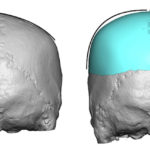
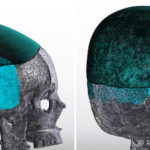
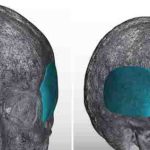
The patient was a young 32 year-old man had some of his skull removed and surgery to reconstruct a shattered eye socket, cheekbone, and leg, following injuries sustained when he fell while climbing up a drainpipe outside his house. To ease brain swelling caused by his fall, a piece of his skull was initially removed which is standard practice in these type of injuries. Also he had titanium plates inserted to fix his broken eye socket and hold the bones together.Six months after his initial injury, the missing piece of his skull was reconstructed with a computer-generated titanium plate based on the shape of his opposite normal skull. Despite restoring the bony shape of the skull, his temple area still remain indented. This is common after such skull procedures as the temporalis muscle, which needs to be raised off of the bone to perform the procedure, will shrink down in size during the healing process.

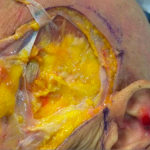
This ‘temporalis muscle atrophy after a craniotomy’ is well known and has been treated over the years by many methods. In this patient’s case, the surgeons used stomach fat harvested by ljposuction which was then injected into the temporal skull defect to fill it out for a smoother contour. How well the fat survived and adequately reconstructed the temporal defect months later was not described in the news story.

Reconstruction of a cosmetic temporal defect can be done with either a synthetic implant, allogeneic tissue grafts or fat injections. There are advantages and disadvantages to any of these approaches. Fat injections, just like they do for every other face and body application, offers a minimally-invasive procedure with a cannula harvest and a needle injection technique. Its disadvantage is in how much of the injected fat will survive. Experiences with temporal fat injections vary widely with some reporting good volume retention and others near complete absorption. I have seen both outcomes in my temporal augmentation with fat. For assured temporal augmentation results, a simple insertion of a specially-designed silicone temporal implant provides a permanent solution.

Dr. Barry Eppley

Indianapolis, Indiana

A New Shaped Implant for the Treatment of Temporal Hollowing

Saturday, July 2nd, 2011

The temporal region of the face, technically the side of the head, occupies an often overlooked aesthetic area. It is bounded superiorly by the anterior temporal line of the forehead, anteriorly by the lateral edge of the bony brow and eye socket, inferiorly by the zygomatic arch and posteriorly by an indistinct margin in the temporal scalp hair. It is not a bony-supported region by rather one of soft tissue, the temporalis muscle and the deep fat pad. The temporalis fascia  covers the muscle and acts like a taut trampoline attached to the surrounding bony edges.

The aesthetic shape of the temple is determined by whether it has a convex, flat or concave appearance. There is no uniform standard or anthropometric measurement to judge what is its ideal shape. A flat or slightly concave temple area appears most common. A bulging or overlying convex appearance is unusual and unappealing and is rarely seen. An overlying concave appearance suggests a sickly or ill appearance. The shape and prominence of the forehead also influences how concave the temporal region will appear.

The most common aesthetic deformity of the temporal region is excessive concavity or depression. It can be caused from surgery (temporalis muscle wasting after a craniotomy), a medical condition (fat atrophy from extreme weight loss or medications) or one’s natural genetics. (congenital lipoatrophy) Regardless of its etiology, some form of an implanted material is needed to build out the temporal depression.

Methods for temporal augmentation have included injected fat, dermal grafts, bone cements or cranioplasty materials and various synthetic implants. Each has their own advantages and disadvantages and have different locations of placement, either above the fascia, below the fascia, intramuscular or on top of the temporal bone. Depending upon the cause for the temporal deformity, there may be benefits to one method of augmentation over the other.

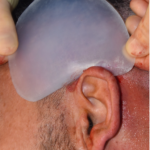
While differing synthetic materials have been used, there has not been few if any preformed temporal implants available. A new preformed temporal implant is now available made out of flexible silicone rubber. Its shape mirrors the natural contours of the inferomedial bony boundaries where the greatest temporal concavity occurs. Its beveled shape allows differential augmentation to be achieved in an anteroposterior dimension so the augmentation is not too excessive near the hairline. Two different sizes are currently available.

Besides the innate flexibility of silicone, the implant is also designed with cross-cut ridges of material underneath to allow even greater three-dimensional implant adaptability. This could be a useful feature to allow the implant to not impede the excursion of the temporalis muscle with mastication.

In aesthetic augmentation, a temporal implant is best placed in the subfascial plane. This is easily done by a small vertical incision in the temporal hairline. This location allows the implant to be placed in a position that maximizes its shaped design. The curved form of this new temporal implant allows it to be rotated in through an incision that is smaller than its widest part. It can also be placed above the fascia but this places the frontal branch of the facial nerve at risk.

In augmentation of temporal defects from craniotomies, the temporalis muscle may be very scarred or severely atrophied. Placing it under the temporalis muscle in these craniotomy-induced defects may be preferable.

This new implant offers another treatment option for temporal hollowing. Its unique shape, flexibility and well-established tolerance to the material is a welcome addition to the expanding number of available cranial and facial implants.

Dr. Barry Eppley

www.eppleyplasticsurgery.com

Indianapolis, Indiana

Minimally Invasive Temporal Augmentation (MITA Procedure)

Tuesday, October 5th, 2010

The temple is a small and often unappreciated region of the face. The most visible part of the temporal region is situated between the side of the eye and the hairline behind it. It is vertically bounded by where it becomes part of the forehead (anterior temporal line) and the zygomatic arch below. (back part of cheek bone where it extends back to in front of the ear) It is primarily made up of the bulk of the temporalis muscle and its underlying fat pad. Normally, it is relatively flat not being too full or indented.

Cosmetic temporal changes do occur and they appear primarily as temporal hollowing or indentations. Too much temporal fullness can occur from overdevelopment of the muscle but this is quite rare. Temporal hollowing can occur from either muscle or fat atrophy. Disruption of the deep and middle temporal arteries is recognized as causing this ischemia. Well known causes are after surgical exposure of the area (neurosurgery or craniofacial surgery), radiation for intracranial malignancies, and traumatic injury. The other recognized causes of temporal hollowing are fat wasting due to automimmune diseases, retroviral medication, and malnutrition. But there is also a cosmetic temporal hollowing that has no obvious causes other than underdevelopment of temporal fullness, what I call congenital temporal hollowing. (CTH) There are some craniofacial syndromes where this occurs but it also appears merely as a cosmetic deformity.

In cosmetic CTH, there is an obvious indentation that is about the size of one’s thumbprint just to the side of the eye. (lateral orbital rim) It is not the size of what one would see from larger temporal hollowing from well recognized causes. But it creates a very visible cosmetic indentation that gives an hourglass shape to the side of the face. Correction of this form of temporal hollowing can be done by variation of traditional temporal augmentation procedures.

Traditional temporal augmentation procedures require extended scalp incisions and the use of some type of hard and soft tissue synthetic implant materials. But the smaller size of cosmetic temporal indentations do not justify these more invasive procedures. A minimally-invasive temporal augmentation (MITA) procedure can be done that is both simple and very effective.

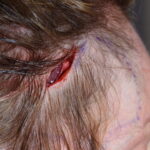
The MITA procedure uses a small 2.5 cm incision located just behind the temporal hairline at the level of the indentation. The incision ends up just below the frontal branch of the superficial temporal artery which is seen just above it during the dissection. The deep temporal fascia is incised and dissection is done in a subfascial plane underneath the indentation out to the lateral orbital rim. This dissection is below the level of the frontal branch of the facial nerve, which is in the more superficial temporalis fascia, so there is no risk of temporary or permanent forehead paralysis. This dissection is easy, quick, and could even be done under local or IV sedation anesthesia.

The critical question is what graft material to use. Since the graft placement is into the temporalis muscle, just about any graft material would work including the full range of synthetic options.  But the use of a more natural or collagen-based material is appealing and the recipient site is ideal. I prefer the use of allogeneic human dermis of which many tissue bank providers exist. (e.g. Alloderm, Dermacell) With thicknesses of 1 to 1 ½ millimeters, it can be layered for increased thickness and cut to any shape. It is easily inserted in a flat or rolled configuration. Enough graft is placed to just slightly overbuilt it. The incision is closed with tiny dissolveable sutures. No dressings are used.

The results of the MITA procedure are immediate and very satisfying. There is no wound care needed with the incision in the hairline. One can shower and wash their hair the next day. There will be some mild swelling and occasionally a little bruising if the fascia attachments along the lateral orbital rim need to be released to get a smooth contour. With dermal grafts, the final volume outcome should await the six month after surgery time period. But their placement in muscle bodes well for long-term volume retention.   

Dr. Barry Eppley

 www.eppleyplasticsurgery.com

Indianapolis, Indiana

Implant Options for Temporal Augmentation

Friday, August 21st, 2009

Temporal hollowing, also known as narrow or indented temples, gives the face (head actually) an unnatural hourglass shape. Rather than a convex transition from the side of the head into the upper cheek area, temporal hollowing shows a concave or sunken contour. Temporal hollowing occurs due to a variety of reasons. Most commonly, it occurs after neurosurgery where a long scalp (bicoronal) incision is used to perform a craniotomy either for tumors or skull fractures. It can also occur as part of certain diseases or medication use that causes facial fat loss. (e.g., HIV) Less commonly, it may also exist as one’s natural anatomy in thinner faces.


Such hollowing can be aesthetically improved through a procedure known as temporal augmentation. There are different materials and methods for changing the tenmporal contour from concave to convex.The key to choosing a successful augmentation method that has a low risk of complications is the condition of the temporalis muscle. Is the muscle completely normal as in the aesthetic patient or is it contracted and thinned from prior surgery or tradiation? The origin of the temporal hollowing, combined with physical examination, will reveal the condition of the muscle.


The temporalis muscle is a large fan-shaped muscle that originates from the temporal line of the skull and extends to insert onto the moveable lower jaw down below. Even in severe atrophy (shrinkage), the temporalis muscle is still moderately thick down near the zygomatic arch. The condition of the muscle higher up is where temporal augmentation takes place and is where the muscle may be most abnormal.


There is no implant material that is universally agreed upon for temporal augmentation. In cases of temporalis muscle atrophy, I prefer in my Indianapolis plastic surgery practice a bone-based approach to implant placement and try and get as much muscle pulled up over it as possible. I prefer a bone paste (hydroxyapatite cement) which is well tolerated and allows for intraoperative custom shaping. I have also used synthetic meshes (most commonly used in abdominal hernia repairs) folded into many layers to achieve the same effect. Given that the implant should ideally end up under the muscle, it is likely that the choice of material is not that important. Also, this type of temporal contouring uses a long scalp incision (which is likely already present from prior surgery) as direct vision and wide open access is needed for their placement and muscle resuspension.


Cosmetic temporal augmentation, however, is different. With a normal muscle, an implant material can be placed under the unscarred and normal fascia which covers the outer part of the muscle. Thus, a much smaller incision isolated to the temporal region can be used through which  a solid implant can be inserted. To keep the incision small, I prefer a silicone rubber implant which is solid enough to slide into the subfascial plane and flexible enough to fit through a more limited incision. Cosmetic augmentations do not usually require as much ‘fill’ as a reconstructive one. It can be surprising how powerful an effect a relatively thin implant can be. Plus it is important to not overdo the size of the augmentation as a bulge is just as unnatural as a concavity.


There are some off-the-shelf temporal implants available from certain manufacturers but they are usually too large and require a lot of downsizing during surgery. They are more ideally suited to reconstructive cases of temporal hollowing after surgery.


Fat injections can also be used for cosmetic augmentation but are not appropriate for cases in which the temporalis muscle is not normal.


Dr. Barry Eppley

http://www.eppleyplasticsurgery.com
http://www.ologyspa.com
Clarian North Medical Center, Carmel, Indiana
Clarian West Medical Center, Avon, Indiana
Indianapolis


Dr. Barry EppleyDr. Barry Eppley

Dr. Barry Eppley is an extensively trained plastic and cosmetic surgeon with more than 20 years of surgical experience. He is both a licensed physician and dentist as well as double board-certified in both Plastic and Reconstructive Surgery and Oral and Maxillofacial Surgery. This training allows him to perform the most complex surgical procedures from cosmetic changes to the face and body to craniofacial surgery. Dr. Eppley has made extensive contributions to plastic surgery starting with the development of several advanced surgical techniques. He is a revered author, lecturer and educator in the field of plastic and cosmetic surgery.

Read More


Free Plastic Surgery Consultation

*required fields


Pricing

The cost of any type of elective plastic surgery plays a major role in the decision to undergo the procedure(s).

More Info


Military Discount

We offer discounts on plastic surgery to our United States Armed Forces.

More Info


Categories