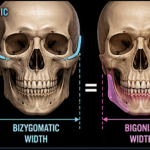
People with a narrow-appearing face have often a deficiency in the width of where the upper jaw and cheek meet, known as the cheek or malar complex. The most common and simple method to improve the amount of cheek that one has is to place a cheek implant. There are some patients who do not want a synthetic implant in their face and may ask if there are any other ways to have ‘more cheek’.
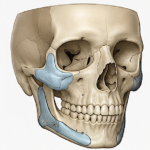
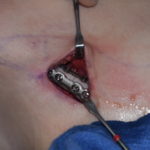
There is one bone-moving alternative. Like the reverse of the bone cut used to make the cheek area more narrower, the cheek can similarly be made wider. Rather than removing a wedge of bone when the cheek cut is made, a single cut is made and the cheek complex pushed out. Because moving the cheek bone out creates a bone gap, the separated edges of bone need to be held apart with a small plate and screws. It is thought best to fill this bone gap with some material but a bone graft is unappealing for a cosmetic procedure. Filling this gap with synthetic bone particles or blocks is one option. I actually prefer not to fill this bone gap at all with the exception of the very top area which can be felt on the outside of the face by the eye. A small piece of ceramic bone substitute can be wedged up high near the top of the bone gap. The rest of the bone gap will fill in and heal over time on its own.
The use of this cheek expansion technique is for a very small number of patients. Cheek expansion builds out the side of the cheek but will not bring it forward or add forward projection, which many patients need more than they do width. Having adequate cheek projection but with a narrow face is a very rare cosmetic problem. Furthermore, there are fewer still that want to go through an operation to correct it. For this reason, cheek bone expansion is an operation of more theoretical than practical significance.
Dr. Barry Eppley
http://www.eppleyplasticsurgery.com
Clarian North Medical Center, Carmel, Indiana
Clarian West Medical Center, Avon, Indiana
Indianapolis
The need to reduce or narrow wide cheeks is a far less frequent request than making them bigger. Most commonly, cheek reduction surgery is requested by Asian cultures, notably Eastern Asians. East Asian cultures value a small face, and wide cheekbones appear to make the face bigger. In rare cases, a patient may have developed a wide cheek(s) due to a facial bone fracture from an injury or may simply have a more flat face appearance which makes the face look wide.
Cheek reduction can be done by two methods, Through an incision from inside the mouth, the prominence of the cheek bone can be burred down or a piece of cheek bone can be removed allowing it to become narrower. Burring down the cheek bone is rarely a good idea. It takes a lot of bone reduction to make a visible external difference and the soft tissues of the cheek may sag after if they do not heal back down to the bone. Taking a vertical wedge of cheek bone out where it attaches to the main bone of the upper jaw, allows the entire cheek bone complex to fall in, narrowing the width of the face. I usually place a very small plate and screws to make sure the outer part of the cheek bone stays in the newly narrowed position permanently. The back end of the cheek bone, where it attaches to the skull (temple) , can also be cut as well as the front end. When both are done together, the face is further narrowed.
While cutting and removing a piece of cheek bone sounds like a complex procedure, it is really quite simple and quick to perform. It is similar to a chin osteotomy but it is easier on the patient as this part of the upper jaw is not responsible for jaw movement even though there are some muscles attached to it. It is far more effective than burring of the cheek prominence and poses no risk of the soft tissues of the cheek sagging after surgery.
Dr. Barry Eppley
http://www.eppleyplasticsurgery.com
Clarian North Medical Center, Carmel, Indiana
Clarian West Medical Center, Avon, Indiana
Indianapolis
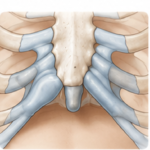
Pectoral implants, the male version of a female breast implant, is a popular option to increase the appearance of chest muscles. Some men desire to improve a congenital chest wall deformity, known as pectus excavatum, while other men have been simply unable to increase the size of the chest muscles with exercise. mass Pectoral implants add size and some definition to the chest because the specially-shaped solid silicone gel material is placed behind the pectoral chest muscle. In thinner men, some definition as well as size may be obtained while ‘thicker’ men may require some discrete liposuction done as well to get better definition and shape to the chest region.
The solid silicone gel implants are very soft, flexible and durable. Do not confuse them with the historic problems associated with old-style silicone liquid breast implants from the 1980s and early 1990s. Solid silicone gel carries no risk of allergic reactions or negative efffects on the immune system. Because of their tremendous flexibility, pectoral implants can be placed through a very small incision high up in the armpit so scarring is generally not visible or a cosmetic problem. The size and shape of the pectoral implant is based on measurements taken from your chest. The implant should never extend below the lower border of the pectoralis muscle and measurements must be taken with that anatomic boundary in mind.
I like to have my patients cease or lessen their chest workouts for several weeks before surgery so that the muscle is not too tight at the time of surgery. Pectoral implant surgery is an outpatient procedure that takes about an hour to perform. I do want patients returning to chest workouts for several weeks after surgery to allow the implant to keep a good position. Unlike breast implants, which can be manipulated into better positions after surgery, this is not possible with pectoral implants. So early aggressive arm motion is not a good thing!
Complications can occur from pectoral implants but, fortunately, are uncommon. Displacement, or asymmetric positioning of the implants, is the most common one that I have seen. Unlike breast implants, pectoral implants are hard to reposition due to the high armpit incision making fine-tuning adjustments of the implant difficult. Fortunately, the shape of a pectoral implant is flat and oblong making the chances of slippage or displacement less than the chances of a female breast augmentation who has a rounder shaped implant. Should one be unhappy with a pectoral implant, it is easily removed.
The costs of male pectoral implants is fairly similar to a female breast augmentation as the procedures are fairly identical in execution and time as are the cost of the implants from the manufacturer.
Dr. Barry Eppley
http://www.eplpeypalsticsurgery.com
Clarian North Medical Center, Carmel, Indiana
Clarian West Medical Center, Avon, Indiana
Indianapolis
Expanding or enlarging the forehead to a more desireable contour is most commonly considered in adults or teenagers who have had a congenital skull deformity. Most of these had some form of craniosyostosis, with or without early craniofacial surgery, and are now left with forehead irregularities, depressions, or a forehead that severely slopes to the temple area making it look too narrow. Other needs for forehead augmentation are from previous trauma cases with frontal bone fractures, neurosurgery patients with craniotomy defects, and rarely a female to male facial conversion patient.
All forehead augmentations use some form of synthetic material to add on top of the bone. The use of acrylic or PMMA, a liquid plastic that hardens after being mixed, has been around for many decades and consistently works well. The more recent uses of bone cements or HA (hydroxyapatite), which similarly harden after mixing, are of more recent use. I have used a lot of each and either PMMA or HA has its own set of advantages and disadvantages. PMMA is less expensive, sets up more reliably in surgery, and can be injected through an endoscopic technique if one wants to avoid a large scalp scar. It also sets up very firmly and gets as hard as any thick plastic material. Its biggest disadvantage is that it is truly a non-natural synthetic material and its long-term implantation may have higher risks of rejection or infection. HA is a more natural material that is similar to bone in structure but it sets up slower and can be more difficult to work with through small incisions. It usually is best placed through a more open scalp incision. Once set, HA is softer than PMMA and if exposed to a large impacting force, it will potentially shatter like a ceramic dinner plate. My decision as to what material to use for any particular forehead depends on the operative technique. For open forehead approaches, I will use HA. For endoscopic techniques, I will use PMMA.
Building up the forehead is similar to sculpting with clay. The forehead bone is exposed and the chosen material is applied and molded into the shape one desires. Whether it is done through an open approach when one uses the fingers to mold and shape or done through an endoscopic technique where the fingers mold it through the forehead skin, the procedure is not difficult and provides an immediate result that should not change over time. The most difficult decision for the patient is whether a larger scalp incision is acceptable or whether the endoscopic ( a few small scalp incisions) approach is preferred. Smaller or spot forehead augmentations can be done endoscopically. Larger or more complex forehead augmentations are best done with an open scalp approach.
Dr. Barry Eppley
http://www.eppleyplasticsurgery.com
Clarian North Medical Center, Carmel, Indiana
Clarian West Medical Center, Avon, Indiana
Indianapolis
The need to change the shape of the forehead or brow bone is very uncommon. Reshaping the forehead or the brow bone (the bone below the eyebrows) is possible but there are different procedures that can be done based on the shape of the forehead and the brow bone.
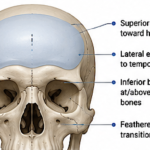
The shape of the skull between a male and a female is often quite different .The male forehead often has fullness over the brow bone known as brow bossing or a supraorbital prominence with a flatter forehead above this area. The female forehead, conversely, has a more convex or curved forehead shape and little or no significant supraorbital bossing. Such forehead shapes confer a masculine or a feminine look.
The degree of brow bossing and the forehead shape helps determine what type of surgical recontouring needs to be done. With the exception of one other important consideration…the frontal sinus. The frontal sinus, an air-filled bone cavity, sits right under the brow bone and how developed it is will affect surgical choices. For this reason, any surgical efforts at forehead/brow modification should have a simple skull x-ray (side view) prior to surgery.
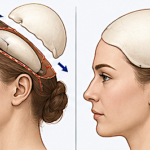
In those patients with mild to moderate brow bossing and thick skull bone over the frontal sinus (or are missing a frontal sinus), bone reduction by burring can be done with a nice result. When brow bossing is present but the bone thickness over the frontal sinus is thin, simple bone reduction contouring is impossible without entering the frontal sinus. Many try just a little bone reduction, without entering the sinus, but this does not make enough difference to justify the effort. Removal of only 1 or 2 mms of bone is not enough to make a difference. In these situation, one option is to open the frontal sinus, burr down the edges of the bone and put the ‘outer lid’ back in a more inward contour, thus preserving the frontal sinus. The other option is to obliterate and fill the sinus with a bone substitute material, making a more flatter brow contour with the bone paste or cement. (and not put the outer table of bone back) I have done both and both of them will work. If I can get a good brow contour and still leave the frontal sinus present and functioning, that is my preferred choice.
Any forehead and brow contouring requires an open approach through a scalp or hairline incision. The forehead skin must be ‘peeled back’ to get good access for the surgery. An endoscopic approach or more limited approach is not adequate to do a good job. In most females, the hairline and hair density patterns make an open approach possible. When this procedure is considered in males, the hair issue makes an open scalp approach potentially more problematic.
The most common patient, in my experience, for brow bone reduction is in female feminization surgery (FFS) where reducing the prominence of the brow bone helps in the overall facial conversion of the male to a female appearance. In a few select males with very prominent brow bones, this procedure can make a big difference in softening the more ‘neanderthal’ facial appearance.
Dr. Barry Eppley
http://www.eppleyplasticsurgery.com
Clarian North Medical Center, Carmel, Indiana
Clarian West Medical Center, Avon, Indiana
Indianapolis
One type of facial implant, and a facial area that can be augmented, is the paranasal area which most have never heard of. The paranasal region is the area just to the side of your nose at the wings of the nostrils. This is an area that is supported by the bone above the front and canine teeth. I became very familiar this area in treating cleft patients where on the side of the cleft the paranasal region was always deficient and sunken in. I frequently built this area back up with bone grafts or implants as an older child or teenager when I did their reconstructive rhinoplasty (nose ) surgery. From this experience, I observed how building out this area affected the face.
Cosmetically, some patients have an overall middle of the face deficiency as the upper jaw is a little short and they have flatter cheeks. Other patients have more ideal facial bone development but, as they age, the overlying nasolabial folds become ‘deeper’ as the cheek tissue descends and falls over the more fixed upper lip tissue. In either case, the use of paranasal implants may be aesthetically helpful.
Paranasal imoplants are very small implants, about the size of a quarter, that are placed on the bone right up against the pyriform aperture through a small incision up under the lip. What is the pyriform aperture you ask? If you look at a skull, you will see the nasal passages in the middle of the face. The lower end of this large opening down near the upper teeth is known as the pyriform aperture. You can easily see the bone right next to them which slopes away. By building up this area, you increase the fullness under the side of the nose.
Paranasal implants, while not commonly done, can be useful as an overall strategy with cheek implants to build out the middle of the face or to help soften the deepest end of the nasolabial fold near the nose.
Dr. Barry Eppley
http://www.eppleyplasticsurgery.com
Clarian North Medical Center, Carmel, Indiana
Clarian West Medical Center, Avon, Indiana
Indianapolis
The popularity of injectable fillers has led some to consider and use their placement way below the skin level down to the bone. In essence, augmenting the bone with an injectable filler. For the cheek and chin area, this seems logical and, indeed, it can be done from a technical standpoint. The question is…is it a good idea?
I have used ‘injectable’ particle materials in the past for facial bone augmentation. At that time, I was occasionally using hydroxyapatite granules with collagen (avitene) powder to make an injectable paste. This was done through small incisions inside the mouth for cheek and chin areas and occasionally for some small forehead defects. The injected paste was mainly hydroxyapatite granules which are relatively permanent and do not dissolve and go away and very well accepted by the body. Furthermore, they became integrated on top of the bone amidst the scar that forms, becoming sort of part of the bone in a natural augmentation procedure.
Today’s injectable fillers, however, are not permanent and will go away, some sooner than others. But more pertinently, the sheer volume of material that it takes to make a difference at the bone level is significant. To really make a visible difference on the outside of the face, you have to add about 3 to 5 ccs at the bone level. You can quickly see that an injectable filler approach to bone augmentation is cost prohibitive and a very poor value given that it is not permament. Traditional synthetic implants, or even old-style hydroxyapatite pastes are far more effective and are a better value for the money, even if it does requires a surgical procedure.
Dr. Barry Eppley
http://www.eppleyplasticsurgery.com
Clarian North Medical Center, Carmel, Indiana
Clarian West Medical Center, Avon, Indiana
Indianapolis
The correction of protruding ears has been done by a variety of procedures over the years, from cutting out skin on the bck of the ear, removing cartilage, and cartilage suturing techniques. Over the years, it has been learned that the removal of skin and cartilage is unnecessary as the problem is not tissue excess, but the shape of the cartilage. Specifically, the shape or absence of shape of the antihelical fold is the problem. Creating the antihelical fold through the use of cartilage sutures on the backside of the ear creates a very natural-looking ear result and should match what one can achieve by folding the ears back with one’s fingers.
This relatively simple procedure is done as an outpatient procedure that generally takes one hour or less to perform on both ears. By making an incision on the back the ear, the cartilage can be reshaped by a suture technique. Sometimes it is necessary to take some skin from the back of the earlobe to get it to fall in line with the shape of the rest of the ear. But this is not always necessary. The ear effect created is immediate and dramatic. In adults, I have them wear a headband to protect the ear for a few days but they can shower the next day and have no fear about gettiing it wet. In children, I ‘childproof’ the ears by a bigger head dressing that stays on for around five days and then they wear a headband after for protection.
The key to a good-looking otoplasty result is that the new ear position must be natural-looking. Overdone ears which are pulled back too far are unnatural and are known as the ‘telephone-ear’ deformity. This problem is difficult to correct unless the patient returns to the oeprating room within a few weeks after surgery.
Otoplasty is a very gratifying operation that has few complications. Beyond the immediate risks of infection or poor correction (which I have not yet seen), the only long-term issue is that the permanent sutures used may eventually come through on the back of the ear. This is a minor problem that is solved in the office. It is very pleasing to see such a simple operation that has such dramatic lifelong self-image benefits.
Dr. Barry Eppley
http://www.eppleyplasticsurgery.com
Clarian North Medical Center, Carmel, Indiana
Clarian West Medical Center, Avon, Indiana
Indianapolis
When one thinks of chin augmentation, most envision simply bringing the chin forward. In many instances, increasing the horizontal projection of the chin is all that is needed or desired. Other patients may want changes in the shape of their chin as well. Revisions of previous chin procedures may only need improvement in its shape rather than more fullness.
Today’s chin implant designs are quite different from those simpler designs from the past. Greater emphasis is placed on the lateral wings of the implant so that a more natural blending of the implant into the bone occurs to prevent any stepoff between the two which might be felt. Implant styles are available that can make the chin broader and more square adding width at the sides, with or without increasing central chin fullness. Chin implants can also have very extensive lateral wings that can help correct one’s ‘marionette lines’ by filling out the loose skin along the jawline. Incredibly, there is even one style which has a central grove in it to help create the appearance of a dimple in the chin. (cleft chin) Not only have the length of the implants increased but there vertical height as well. Increasing the height of a chin implant can help decrease the depth of the labiomental sulcus below the lower lip.
There are many different chin implant styles and sizes today. (28 from one manufacturer!) Careful assessment of one’s chin may reveal that the cosmetic enhancement may be improved by more than just increased chin fullness. The chin is truly a three-dimensional facial shape that can be favorably changed by the shape of the implant chosen.
Dr Barry Eppley
http://www.eppleyplasticsurgery.com
Clarian North Medical Center, Carmel, Indiana
Clarian West Medical Center, Avon, Indiana
Indianapolis
While many types of implant materials have been tried for use in the face, only a limited few have enjoyed a history of good clinical success. Today’s facial implants are composed of the synthetic polymers dimethysiloxane (silicone), polyethylene (Medpor), polytetrafluoroethylene (Gore-tex), and polyester. (mersilene)
The use of solid silicone rubber (solid, not liquid silicone) have been used as facial implants material for nearly four decades. Silicone implants are by far the most type that are used in the face. Silicone is a essentially a form of plastic created from interlinking silicon and oxygen into a compound known as dimethylsiloxane (SiO(CH3)2) . Its chemical advantage is that it is very resistant to breaking down to the very strong and stable silicon-oxygen bonds. When converted into a polymer and vulcanized, a solid silicone rubber which is elastic and very flexible is formed. When shaped into a facial implant, it has the advantages of ease of placement through small incisions due to its flexibility, can be easily cut and shaped if necessary during surgery, and are of low cost.
Like the material used in coats and shoes, Gore-Tex has been used as a facial implant since 1994. It has been used as more traditional shaped implants for the cheeks and chin as well as soft tubes to be used right under the skin as a soft tissue filler. Gore-Tex is really polytetrafluoroethylene, a fluorocarbon which has a carbon ethylene backbone to which is attached four fluorine molecules (PTFE). The bonding of highly reactive fluorine to carbon creates an extremely stable biomaterial which the body can not break down due to the lack of any known human enzyme to disrupt the fluorine-carbon bonds. The material is extremely flexible and is easily cut and shaped. The fabrication of Gore-Tex results in small interconnected pores on its surface and throughout the material which may allow for some tissue ingrowth. The advantage of tissue ingrowth is probably more theoretical than of any practical significance.
Medpor, known chemically as polyethylene (PE) has been used in the face for over a decade. It is different than Gore-Tex (PTFE) as it has no fluorine molecules in it. The chemical structure may be simple but it has a very firm consistency that makes it the hardest facial implant used. It comes in different facial shapes and sizes and, although it can be shaped, it is not easy. The material does have small channels through it which allows for tissue ingrowth into it. That makes it harder to remove if necessary due to the sticky scar.
Mersilene is a knitted plastic mesh material most commonly used to fix abdominal hernias. It has been historically used in facial surgery where it has been used as a chin implant. The mesh material is rolled onto itself, shaped, and then sewn together to create the implant. Because the implant is a mesh, it has lots of holes in it for tissue ingrowth. The few surgeons who use mersilene do it because they like to fashion their own implants and can do so at a lower cost than buying other off-the-shelf implants.
Your plastic surgeon may use any of these materials for your facial implant surgery. While silicone rubber is the most commonly used, all other materials are acceptable and very well tolerated by the face. Tissue ingrowth into facial implants with pores or channels, while theoretically appealing, has not been proven to offer any advantages over completely solid silicone rubber implants.
Dr. Barry Eppley
http://www.eppleyplasticsurgery.com
Clarian North Medical Center, Carmel, Indiana
Clarian West Medical Center, Avon, Indiana
Indianapolis