
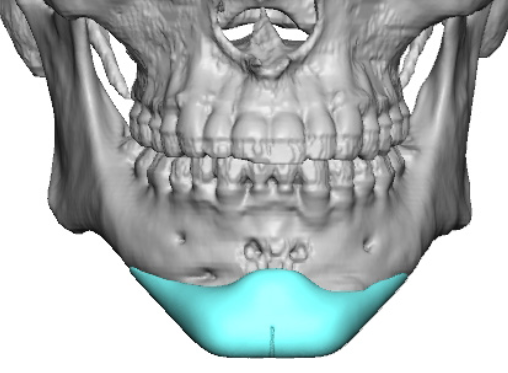

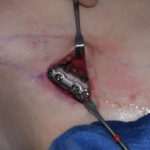
Vertical chin length (the height of the lower third of the face) is usually evaluated using proportional relationships rather than just raw millimeters—but we can translate those into practical numbers.
1. Facial thirds (core framework)
The face is divided into three vertical sections:
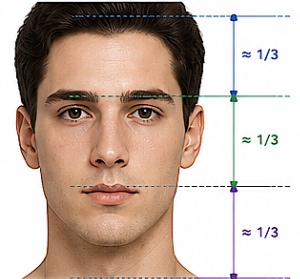
- Hairline ? brow
- Brow ? base of nose (subnasale)
- Subnasale ? bottom of chin (menton) ? this is the chin/lower face
Ideal:
- All three thirds ? equal
So vertical chin length = ~? of total facial height
2. Lower third breakdown (more precise)
That lower third is further divided:
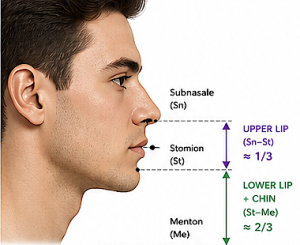
- Upper lip (subnasale ? stomion) ? 1/3
- Lower lip + chin (stomion ? menton) ? 2/3
And within that:
- Chin itself (labiomental fold ? menton) is a major component of that lower segment
3. Real-world millimeter ranges
These vary by sex, size, and ethnicity, but typical ballpark:
Males
- Total lower third: 65–75 mm
- Chin height (fold ? menton): 35–45 mm
Females
- Total lower third: 60–70 mm
- Chin height: 30–40 mm
4. What counts as short vs balanced chin (vertical)
Short chin (vertical deficiency)
- Chin height < ~30 mm (female) or < ~35 mm (male)
- Lower third looks compressed
- Often paired with a deep labiomental fold
Average / balanced
- Chin proportion fits the 1/3–2/3 rule
- Smooth transition from lip ? chin
5. Surgical movement ranges (vertical genioplasty)
- 2–3 mm ? nearly imperceptible
- 4–6 mm ? visible;
- 6–8 mm ? moderate
- 8–10+ mm ? large
- > 10mms very large/extreme
Vertical changes are very noticeable because they alter:
- Lip competence
- Labiomental fold depth
- Facial thirds balance
6. Key aesthetic checkpoint
It’s not just chin height alone—one also needs to look at:
- Incisor show at rest (~2–4 mm ideal)
- Lip length
- Labiomental angle (~120–140°)
A long chin with a short upper lip can look very different than a long chin with a long upper lip.
Bottom line
- Chin height is judged mostly by proportions, not just mm
- Roughly 30–45 mm is typical range
- >10 mm surgical change vertically is needed if patient wants a very visible change
- Extreme amounts of chin lengthening can reach 15mmd or more
- Extreme chin lengthening and how to achieve is largely undescribed….other than that can not be done by most surgeons
Case Example
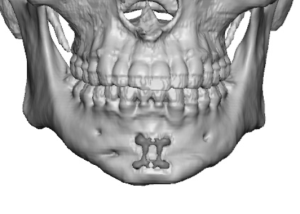
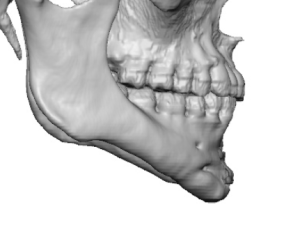 This male desired a chin augmentation effect that was best shown by jutting his jaw forward, providing both a vertical and horizontal increase in projection. As a result, using the jutting jaw forward measurements, he underwent a vertical lengthening bony genioplasty of 6mms vertical and 6mms horizontal for a 45 degree augmentation effect.
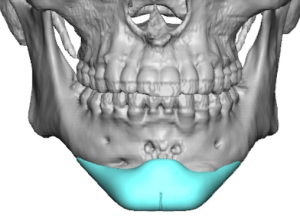
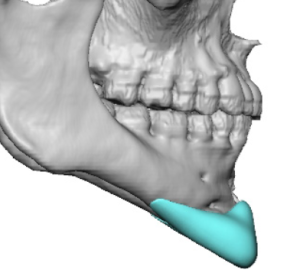 While this was a good improvement he came back six months later to take the result even further for a second genioplasty for primarily a vertical lengthening effect. A custom chin implant was designed to cover the bony genioplasty with 4mms horizontal projection and 8mms vertical length. A more square-shaped chin was also built into the design. The custom chin implant was placed through a submental skin incision.
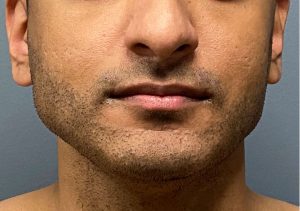
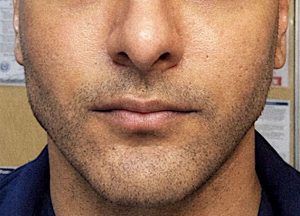
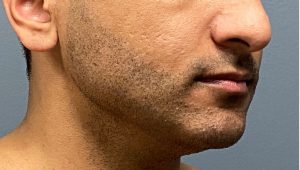
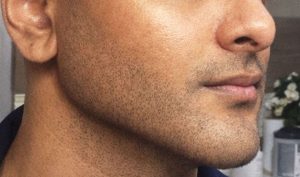 This produced a more profound change in the projection of thechin changing it from an initial shorter chin to a very strong chin appearance. The total chin augmentation changes amounted to 14mms of vertical lengthening and 10mms horizontal augmentation. Such dimensional changes could not be achieved by either a bony genioplasty or a custom chin implant alone.
Discussion
Extreme vertical chin augmentation usually refers to surgical procedures that significantly increase the height of the chin beyond subtle or “natural” enhancement. It’s most commonly done through genioplasty (sliding chin surgery) or large/custom chin implants, depending on the goals and anatomy.
Here’s how it breaks down:
1. Sliding Genioplasty (most powerful option)
- The surgeon cuts the chin bone and repositions it downward which may or may not have some forward advancement as well
- Can create more significant lengthening
- More control over the soft tissue chin pad positioning
- No foreign implant, so lower long-term risk of shifting or rejection
- Longer recovery than implants
2. Chin Implants (custom)
- Implants placed over/under the bone.
- Requires custom-designed implants for primary vertical lengthening
- Must be placed through a submental skin incision to get proper implant positioning
- Less invasive than genioplasty, but:
- Limited to 7mms or less of vertical lengthening due to limits of soft tissue chin pad stretch
3. Combination approaches
- Bony genioplasty + implant as a two stage chin lengthening for a more profound lower facial third effect.
- The implant is the overlay on the 1st stage bony genioplasty
Who considers this?
- People with very short chin height
- Flat mandibular plane angle
- Chin looks compressed with deep labiomental fold
- Pseudo soft tissue chin pad protrusion
- Patients who may seek an extreme or non-normalized chin augmentation result
Big Picture
Two stage vertical chin lengthening employs a 1st stage vertical chin lengthening osteotomy and a 2nd stage custom chin implant. The ratio between the two lengthening effects can vary although the bony chin lengthening should have the dominant lengthening effect by the amount of dimensional change.
Dr Barry Eppley
Plastic Surgeon