
Archive for the 'chin reduction' Category
Background: The prominent position of the chin makes it have a significant impact on one’s facial appearance. While most chin surgery involves implants for a small or horizontally short chin, a larger or more prominent chin is equally disturbing although less common. Because chin reductions are infrequently done, there is less information available on techniques and outcomes for it.
Compared to chin augmentation which is more common in men, chin reduction is more frequently requested in women. Even a slightly too prominent chin is less aesthetically tolerated in women as opposed to men. Long chins, pointy chins, and those that stick out too far are common chin complaints from women. A chin can be too long vertically, too far forward horizontally, have a too wide or too pointy shape, or some combination of several of these features. Diagnosing the exact dimensional problems with the chin is critical is determining the best way to shape it.
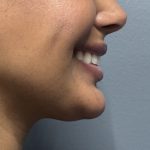
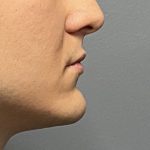
This is a case of a 35 year-old female who has been bothered by her chin shape since she was a teenager. She felt that is was too long and pointy, particularly in a profile view. She despised her appearance in a picture from the side. She stated that the pointy nature of the chin became worse when she smiled.
In looking at her chin, its shape problems can be identified as largely horizontal (too far forward in profile), slightly long vertically (emphasis on slight), and with a mildly pointy shape. The pointy shape becomes more obvious when she smiles as the soft tissues around the mouth and face are pulled backwards against the hard outline of the chin bone.
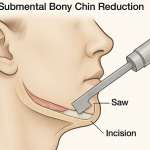
Chin reductions always involve bone removal and reshaping. There are only two basic approaches, burring down the bone or cutting off the end of the chin bone and repositioning it. (chin osteotomy) Both of these chin reduction methods must always take into consideration how the surrounding soft tissue will adapt. One must remember that less enveloping soft tissue is needed afterwards. For this reason, horizontal chin reductions are best done by burring and excising and tightening the soft tissue envelope through an incision under the chin. Vertical chin reductions are best done by osteotomies which removes a wedge of bone. The soft tissues of the chin have less risk of excess and redundancy when reduced in vertical height.
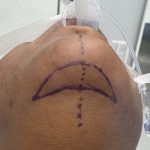
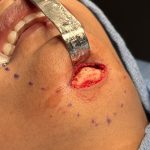
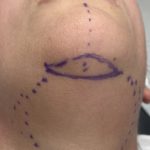
Planning for this patient’s chin reshaping showed the desired movements of 7mm horizontal reduction, 2mms vertical reduction and flattening of the lower border to round out its shape. (get rid of the point) The chin reduction was done through a 3 cm long submental incision using a burr to do the reduction. Excess muscle was excised and plicated over the freshly burred lower border. Skin excess was then removed and the incision closed. A chin pressure dressing was used for just 24 hours.
Chin reductions do result in some discomfort, very similar to a chin augmentation with an implant. There are no restrictions after surgery and one can eat and drink unaffected. It takes several weeks for the major swelling to subside and the final result can be appreciated in 6 to 8 weeks. The chin will usually appear tight and look stiff for the first few weeks after surgery.
She was very pleased with her outcome and felt it made a very noticeable change in her chin appearance. She no longer felt that her chin was pointy. With her original chin problem (horizontal), the result is most noticeable in profile views.
Case Highlights:
1) Chin reductions is largely a female request with the desire to get rid of a prominent chin that is either too long, strong, or both.
2) Horizontal chin reductions are best done by burring and muscle and skin tightening to avoid soft tissue sag. A submental incision is used which results in a well-placed scar.
3) Reducing a prominent chin has about the same recovery time as a chin augmentation. However, it takes longer to see the final result as small amounts of swelling takes months to completely go away.
Dr. Barry Eppley
Indianapolis, Indiana
The chin is the predominant feature of the lower face. Whether it is too short or too long affects the overall look of one’s face. While short chin deformities make up the vast majority of corrections, long chin problems also exist. The overly prominent chin can exist in two dimensions, too far forward (horizontal excess) or too long. (vertical excess)
Chins that are too long vertically are the result of excess bone development. Unlike chins that are too long horizontally, this is usually not an overgrowth problem of the entire lower jaw where a bite deformity (underbite or malocclusion) may also be present. The bone height of the chin (mandibular symphysis) is simply too long from below the tooth roots downward.
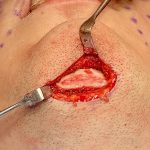
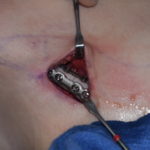
Vertical chin reductions are all about having to remove bone. It would be very rare to consider removing bone by simply shaving down some off of the bottom part of the chin. This usually does not result in enough removal but, more importantly, risks loosening up the muscle and soft tissue attachments which will likely not reattach afterwards. This will result in hanging soft tissue, known as a witch’s chin deformity, and will likely look worse than the original problem. Vertical chin reductions are best done by removing a wedge of bone between the upper and lower portions of the chin. This will not disturb the soft tissue attachments and will result in a more significant change. The approach is through the mouth so there would be no external scar. The chin bone is put back together in a shortened position with very tiny titanium plates and screws.
Any chin reduction procedure must consider the potential effects of the soft tissue envelope. Much like changing a breast implant to a smaller one, what happens to the expanded or stretched out soft tissue afterwards? In my Indianapolis plastic surgery experience, this is a more significant issue with horizontal reduction but it still must be considered with vertical reductions as well. In either case, the mentalis muscle must be shortened and resuspended tightly. Vertical chin reductions do not require skin shortening by excision unlike most horizontal chin reductions. The finesse part of any bony chin procedure is the management of its soft tissue attachments. Failure to do so will likely result in secondary chin problems
Dr. Barry Eppley
http://www.eppleyplasticsurgery.com
Clarian North Medical Center, Carmel, Indiana
Clarian West Medical Center, Avon, Indiana
Indianapolis
The chin is the most dominant feature of the lower face. It has significant influence on the perception of facial balance and how the neck looks as well. While the chin may only be thought of as being too small or too big, there are other dimensions to the chin that also play a role in how it looks. Its horizontal position relative to the rest of the face can be an overly simplistic view of its aesthetics. The width of the chin is also important. Men often want a wider chin, women usually desire a chin that is more narrow.
When it comes to building out a chin, whether it be for horizontal length or width, the use of an implant is a simple and very effective method. Reducing chins, however, require manipulation of the bone…specifically removing parts of the chin to change its shape. Subtraction is a slightly more complex maneuver than addition for all facial areas.
Broad chins can be reduced through a technique known as an oblique chin ostectomy. This is a method where bone from the side of the chin along its undersurface is removed. This can be done by burring it down, or more effectively, by sawing away the widest part of the chin and making it blend into the jawline. It can be done from either inside the mouth or from a small incision under the chin. As the bone is removed in a front to back direction, how much bone to remove and how it affects the narrowing of the chin can be seen quite easily. This procedure can be done alone or with any other chin operation, including implants. For a wide and short chin, for example, a central chin implant style can be placed with lateral narrowing to make for a slender narrower chin. This operation does cause some significant swelling, as bone manipulations will do, and some temporary numbness of the chin and lower lip as well.
Narrowing of the chin adds another method of cosmetic jaw enhancement including chin implants, chin, osteotomies, mandibular angle implants, and mandibular angle reduction. Chin narrowing can be done alone or in combination of any other chin/jaw method to create an overall lower jaw shape change. These changes are particularly visible through computer prediction imaging and, in my Indianapolis plastic surgery practice, I make sure that all such patients go through such imaging before surgery.
Dr. Barry Eppley
http://www.eppleyplasticsurgery.com
Clarian North Medical Center, Carmel, Indiana
Clarian West Medical Center, Avon, Indiana
Indianapolis
Chin reduction is a form of chin reshaping surgery that involves changing the size and possibly the shape of the chin in order to make it appear smaller. This surgery may be beneficial to those who have a large chin that looks disproportionate when compared to the rest of the face. A chin may look too large in two dimensions, either being too long vertically or projecting too far forward horizontally. In rare cases, both dimensions of chin enlargement may be enlarged but usually it is one or the other.
Vertical chin enlargement is corrected by a wedge ostectomy of the chin. Through an intraoral approach, the chin bone is exposed and a reciprocating saw is used to remove a horizontal wedge of bone of the desired thickness. Usually it takes at least 5 to 6mms of bone removal if not more to make a real noticeable difference. Small plates and screws are used to hold the shortened chin bone together so that it can heal. The edges of the upper bone cut must be smoothed so it is not able to be felt through the skin.
Excessive horizontal chin excess is done through a burring down and tissue resuspension technique. Through an incision underneath the chin, the bone is exposed and the desired amount of excess bone removed. Because the attached soft tissues have had to be stripped off of the bone, they must be reattached or sagging (witches chin deformity) will occur afterward. Excess muscle and skin are removed and sutures are used to reattach them tightly to the bone.
All chin reduction methods require careful attention to how the bone is taken down and whether the soft tissues remained attached to the bone. Simple ’sanding down’ a prominent chin, as has been done by many in the past, will only lead to secondary chin problems.
Frontal and profile photographic analysis should be done before surgery to determine how much bone reduction is needed. Since there is a pretty good linear relationship between bone changes in the chin and changes seen externally, photographic analysis is useful in all types of chin surgery.
Dr. Barry Eppley
http://www.eppleyplasticsurgery.com
htttp://www.ologyspa.com
Clarian North Medical Center, Carmel, Indiana
Clarian West Medical Center, Avon, Indiana
Indianapolis
The chin represents one of the five main prominences of the face, also including the nose, brow ridges/forehead, cheeks, and jaw angle. It is the defining feature of the lower face. Augmentation or enhancement of a recessed or weak chin is a common plastic surgery procedure that is made fairly simple through the placement of a synthetic implant. Correction of a large or too prominent of a chin, however, is not only less commonly done but is more difficult to do successfully.
A prominent chin has both excess hard and soft tissue. This means that the bone not only has to be reduced but the muscle and skin must be shortened and tightened as well. If the soft tissue of the chin is not properly addressed in a reduction, it will sag off of the reduced bone after surgery resulting in what is known as a ‘witch’s chin’ deformity.
Chin surgery is traditionally done through an incision under the chin in the submental crease. But in a chin reduction procedure, this incision should be moved back a bit accounting for the removal of some submental skin at the end of the procedure. Once the chin bone is exposed, the excess chin is burred down the amount estimated beforehand. Usually it takes at least 6 to 8mms to make a significant difference. It is important to make sure that the bone removed extends far enough to the sides and is tapered to keep the chin from being too square. Once the bone is removed, excess mentalis muscle is removed and this muscle flap is sutured to the underside of the chin to the platysma muscle. Making this a tight muscle closure is important. Redundant overlying submental skin is then removed and closed as well. The soft tissue closure is just as important as the bone removal.
This approach works well for a horizontal chin excess. A vertical chin excess or a long chin, however, requires an intraoral approach with an interpositional wedge osteotomy for its correction. This is a completely different operation with removal and repositioning of bone rather than a simple burring down technique.
Dr. Barry Eppley
http://www.eppleyplasticsurgery.com
Clarian North Medical Center, Carmel, Indiana
Clarian West Medical Center, Avon, Indiana
Indianapolis
Moving the chin bone is the simplest of all the cosmetic facial bone procedures. Because the chin is easy to get to through the mouth and there is little in the way to get there, cutting and moving the chin bone (the tip of the front of the lower jaw) is relatively easy do and commonly done. Besides cutting and moving the bone forward to create more chin prominence, bone manipulations of the chin can be much more than just traditional horizontal augmentation.
When the chin bone is cut and dropped down, there are many different shaping procedures that can be done to it. By making a horizontal bone cut below the front teeth, the chin can be changed in length. A wedge of bone can be cut out and the chin brought back up to shorten it in height. Conversely, the chin can be lengthened by placing a bone graft or a piece of synthetic bone in between the two cut ends to make the chin vertically longer. If the chin lengthening is relatively small (a few millimeters), nothing may need to be put in the gap between the bone pieces.
Aside from height changes, alterations can also be done in chin width. The chin bone once cut and brought down from the rest of the jaw, can be widened or narrowed as well. By removing a piece of bone down the middle of the chin bone, it can be brought together in a more narrowed fashion, Similarly, a bone cut can be made down the middle of the chin and it can be split apart and widened. (similar to what it done for lengthening the height of the chin)
With all of these chin changes, small plates and screws are needed to hold the bone segments into the desired positions. This metal hardware is very small and can never be felt from the outside. Over time and with healing, bone overgrows much of these plates and screws. I have never had to remove plates and screws from the chin due to problems with them. They are made of titanium, which is a non-magnetic metal, so there is no concern about ‘setting off the detector at the airport’.
Orthopedic surgery of the chin offers some advantages over more simple chin implants, particularly in changing the dimensions of chin shortening, chin narrowing, and chin lengthening. These are chin changes that implants can not do as their effects are additive, not reductive.
Dr. Barry Eppley
http://www.eppleyplasticsurgery.com
Clarian North Medical Center, Carmel, Indiana
Clarian West Medical Center, Avon, Indiana
Indianapolis
Chin reduction is a far less commonly performed procedure than a chin implant or chin augmentation. I would have to estimate that I perform only one chin reduction for every 20 to 25 chin enlargements or enhancements that I do. Not only is it a more uncommon chin procedure, it is also one fraught with many more potential cosmetic complications. Like most of plastic surgery, it is always easier to enlarge a body part than it is to aesthetically reduce it.
Chin reduction may be beneficial when, in side view, the projection of the chin exceeds a vertical line dropped down from the forehead. Anthropometrically, the chin should fall either on this line or slightly behind it to be classically adequate and pleasing. However, chin reduction (or more accurately narrowing) may also be beneficial if the chin in a frontal view is too wide or square. This is usually an issue in women and not men.
In minor cases of excess chin, camouflaging procedures such as cheek implants or rhinoplasty may negate that appearance if those surgeries are indicated. Usually, however, only some form of chin reduction will make the necessary aesthetic difference. Chin reduction surgery is done through an incision under the chin in the skin crease. Muscle is lifted up off of the chin bone (front part of the jaw) and a burr is used to reduce the prominent central area, feathering out into the sides of the chin bone. While any amount of bone can be removed, excess reduction is not advised as this will create a soft tissue redraping problem. Once the bone is reduced, you actually need less muscle and skin underneath. If the muscle is not adequately resected and tightened, you may end up with a ‘witch’s chin’ deformity where the soft tissue sags off of the bone due to lack of support for that amount of tissue. This is a common problem with this operation when done by someone inexperienced and unappreciative of the nuances of the chin reduction procedure. Problems are usually avoided of the bone reduction is not overly aggressive and attention is paid to good soft tissue resuspension and support.
I always advise patients that, unlike a chin augmentation where a very big difference can be achieved, chin reduction is about a more subtle change and is never as dramatic a difference. It is, nonetheless, a gratifying procedure when done well and the recovery is no more significant than a chin augmentation. Chin reduction, when combined with other midfacial enhancement procedures at the same time, produces an even better aesthetic change in one’s facial profile.
Dr. Barry Eppley
http://www.eppleyplasticsurgery.com
Clarian North Medical Center, Carmel, Indiana
Clarian West Medical Center, Avon, Indiana
Indianapolis
While chin enhancement in both increased projection and width is desireable in men, the exact opposite is true in women. A narrower more refined chin helps contribute to a more oval facial form. When one looks at a woman’s face and it is more square, the question is whether this is due to a bony prominence at the mandibular (jaw) angles, whether it is due to a square chin shape, or both. If a wide square chin is the main contributor to the undesired lower facial contour, then bony reduction of the chin can be performed.
Bony chin reduction by burring or shaving down the lower border, in my experience, produces only a minimal result. In addition, it also has the risk of creating a soft tissue sag due to the extensive stripping of the soft tissue off of the bone in order to be able to do the procedure.In the July2008 issue of Plastic and Reconstructive Surgery, Park and Hoon Noh from Korea address chin narrowing by a chin osteotomy and midline resection. This is an easy variation of a chin osteotomy and I have also found it very successful for chin narrowing. (and it can be used for chin widening as well) One of the key technical points is to make sure to burr down the edge of the bone where the lateral side of the chin is moved in and to resuspend the mentalis muscle well. The risk of temporary mental nerve numbness should be the same as with shave reduction only as nearly same amount of soft tissue stripping is needed.
Like all chin osteotomies, there is more swelling and temporary numbness than will occur from a chin implant for example. But the long-term result is worth it. Chin narrowing, combined with mandibular angle reduction, can be very effective in the most square of faces.
Dr. Barry Eppley
http://www.eppleyplasticsurgery.com
http://www.ologymd.com
Clarian North Medical Center, Carmel, Indiana
Clarian West Medical Center, Avon, Indiana
Indianapolis