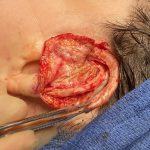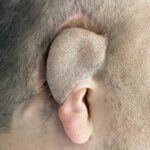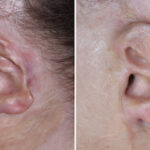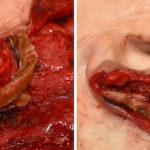
The ear may be quite small, measuring only about 5 cms in height and 3 cms in width, but it has the most complex anatomy of any facial component. Its many ridges and convolutions comprised only of cartilage (and the overlying skin), surrounding the ear hole, give it a distinct shape that is uniquely recognizeable as an ear. But within its complex geometries lie some basic architecture that guides how otoplasty (ear pinning) or ear reconstructive surgery is done.
On a simplistic level, the ear is three levels or tiers. An amphitheatre that encircles a central stage if you will. The outer or top layer is the outer rim of the ear known as the helix and it sits the highest. (farthest away from the side of the head) The next step down is an inner rim or antihelix which parallels the helix for the most part but at a lower level. And the final step down into the hole, so to speak, is the bowl or concha. Understanding the three tiers or levels of the ear is to understand how to surgically change it.
In otoplasty, often called ‘pinning back the ears’, the anithelix is missing. (the fold is not there) So to move the ears back, the cartilage from behind is sewn closer together to make an antihelix or antihelical fold, thus moving the helix and ear back closer to the head. How snug or loose these shaping sutures are placed determines how close the ear sits to the side of the head. In some cases of protruding ears, the bowl or concha is also too big. So the concha from behind may be cut down in size by cutting out a wedge or sewn directly back, this also moving the ear back. Since otoplasty is mainly about shaping the cartilage with sutures, this is why it is a simple and fairly quick operation…but with a very powerful visual effect.
Conversely, ear reconstruction can be quite complex. In children born with much or all of their ear missing (known as microtia), complex cartilage grafting must be done. This often involves taking rib cartilages, putting them together, and carving out an ear framework. And how is the framework pieced together and carved? Based on the three-tier principle of ear architecture! Helix, antihelix, and concha.While ear reconstruction is multiple stages and is not based solely on the cartilage framework that is put under the skin, it all begins with a well-fabricated cartilage framework. Onto that are finer details of the lobule and other shaping procedures (more minor) which are done later.
Dr Barry Eppley
http://www.eppleyplasticsurgery.com/
http://www.ologyspa.com/
Clarian North Medical Center, Carmel, Indiana
Clarian West Medical Center, Avon, Indiana]
Indianapolis
One of the recent trends of personal marking or adornment is that of gauging. Similar to piercings, gauging is basically an extension of this concept only with an end result of larger holes and jewlery. It is done by starting with a traditional piercing, usually in the ear, and then gradually enlarging the piercing hole by the slow sequential replacement of a ‘hole expander.’ Over time, the earlobe hole gets stretcheduntil it can accomodate a metal insert that is often larger than the original size of the earlobe.
Gauging is undoubtably a short-lived phenomenon done mainly in the young. Eventually, most people with gauging piercings or jewelry may want it reversed. Fortunately, in the ear, this is fairly easy to do. Because no actual earlobe skin has been removed, but merely stretched, its correction is similar to that of an earlobe reduction procedure. The edges of the enlarged hole are excised and brought together, restoring the earlobe to a near normal size.
In areas other than the earlobe, however, gauging is not so easily corrected. In other parts of the ear, there would be loss of cartilage (unlike the earlobe which is only made made up of skin) and this can be replaced. Such holes in cartilage-containing part of the ear must be cut out with significant alteration of the size and shape of the ear to close it.
Dr Barry Eppley
http://www.eppleyplasticsurgery.com
http://www.ologyspa.com
Clarian North Medical Center, Carmel, Indiana
Clarian West Medical Center, Avon, Indiana
Indianapolis
Protruding Ear Correction
While there are many other plastic surgery procedures that are more popular, one of the most simple and dramatic procedures is that of otoplasty. Performed in around 20,000 Americans last year, it has one of the most dramatic effects on self-image of any operation in plastic surgery. Usually done in younger patients (most commonly under age 18), often those teased throughout school due to their ‘dumbo’ ears, the ears are reshaped so that they lay closer to the side of the head.
The operation is done by cutting on the back of the ears, exposing the back surface of ear cartilage. Special sutures are placed to bend the right area of the cartilage to create a helical rim (outer aspect of the ear) that sits back further. The tightening of the sutures determines how far back the ear is set. You don’t want to overtighten these sutures. If you do, you will create the classic ‘telephone-ear’ deformity. (the ear plastered against the side of the head) Overcorrection is impossible to fix later, undercorrections (while also not desireable) can at least be set back further later.
In children, the procedure is done under general anesthesia in the operating room. In select adults, it can be done under local anesthesia in the office. While in young children (under age 8), I put a head dressing on for a week, in adults I only use it for one day. While some ear swelling is seen for a few weeks, the surgical results are immediately apparent. One other benefit, there is some ear soreness but no real acute pain with the procedure.
I often joke that many otoplasties are done in children in the spring, when the winds pick up.
Dr Barry Eppley
www.eppleyplasticsurgery.com
www.ologyspa.com
Clarian North Medical Center, Carmel, Indiana
Clarian West Medical Center, Avon, Indiana
Indianapolis