EXPLORE
Plastic Surgery
Dr. Barry Eppley

Explore the worlds of cosmetic
and plastic surgery with Indianapolis
Double Board-Certified Plastic
Surgeon Dr. Barry Eppley

Archive for the ‘midface lift’ Category

The Endoscopic Midface Lift With Malar Augmentation - Rejuvenation Of The Aging Cheeks

Sunday, March 20th, 2011

The midface is the most difficult part of the face in which to reverse the effects of aging. While the upper face (forehead) can be very successfully treated by different forms of a browlift and the lower face (neck and jowl) with facelift variations, improving sagging cheeks poses different challenges. The presences of the eyes and the bony orbit prevents a straightforward upward vector for soft tissue re-suspension and easy incisional access.

While the cheek tissues sag and falls vertically, any method of soft tissue re-suspension must be in an oblique and not vertical vector because of the eye above it. In addition, the lower eyelid and its rather delicate suspension system holds it uptightly against the eye. While eyelid incisions are commonly used for midface lifts, they definitely pose risks for lower eyelid sag problems if any tension is placed upon them or they are not meticulously put back together.

This is why the endoscopic approach for midface lifts can often be the best and safest approach. Through a combination of a temporal hairline incision and a mucosal incision inside the mouth, an uncomplicated dissection can be done in the subperiosteal plane. Such an approach avoids the problems associated with eyelid incisions and potential postoperative ectropion. Dissection between these two points is joined over the body of the zygoma. The wide connection between the temporal and intraoral pockets allows for tissues to be lifted for a volumetric change at the zygomaticomaxillary point.

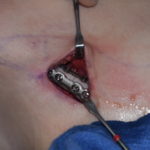
One complement to a midface lift is cheek or malar augmentation. There are two approaches, synthetic or a natural source of cheek augmentation. Before suspension, a small cheek implant can be used to add further volume at the height of the existing cheekbone. It would be important to screw this implant into position given the wide open tunnel from the endoscopic dissection. The other option that I have used in some cases would be to use the buccal fat pad as the implant. By mobilizing it from its submalar location, it can be draped up over the cheek by an additional suture passed up to the temporal region.

In the world of facelifting, emphasis has been finally placed on rejuvenating the midface and improving the eyelid-cheek interface. Unlike other areas of facial rejuvenation, however, there are real risks from problems caused by incisions to do the procedure. This makes doing a midface lift using non-eyelid incisions appealing if possible. A lower blepharoplasty can be done with the midface lift and often some skin removal may be necessary as the cheek tissues are pushed upward.

Dr. Barry Eppley

www.eppleyplasticsurgery.com

Indianapolis, Indiana

The Role of Mid-Face Lifts in Facial Rejuvenation

Wednesday, August 26th, 2009

As one ages, changes take place in the face from top to bottom. While changes in the neck and jowl are most commonly observed, the middle part of the face is also affected. Sagging cheeks and deepening nasolabial folds are the hallmarks of midfacial aging. Different approaches are taken to address these issues including cheek implants and injectable materials for filling out the nasolabial folds. For the right patient, however, a mid-face lift may be more effective and the results can last much longer.


A mid-face lift approaches the cheek through a combination of incisional approaches, including the lower eyelid and scalp and occasionally through the mouth as well. All are designed to free up the cheek tissues and move it back up on the bone. The key to understanding the procedure, and how well it works, is how it is secured in its new position. There have been numerous methods of cheek suspension and there is no universally agreed on approach. In my Indianapolis plastic surgery practice, I prefer a superior or scalp point of fixation in which sutures from the cheek are attached to the skull above the forehead. This  provides tremendous tissue support and places no tension on the tissues around the eye. It is easy to pass sutures underneath the forehead tissues which gives a perfectly vertical line of suspension. The sutures are attached to the bone either through a bone tunnel or a resorbable screw. Getting the right amount of lift without overdoing it is key to avoid a very visible unnatural look around the eyes.


Many tout that a mid-face lift has a faster recovery with less trauma than a full face lift. I would disagree. The swelling around the eyes is much more noticeable and bothersome than any neck swelling. The swelling around the eyes does not fully go away for several weeks. This is an important consideration when one is considering this procedure.


Often mid-face lifts are done in conjunction with blepharoplasty and necklift procedures as aging of the face rarely occurs in just one specific area. A common combination is as part of periorbital rejuvenation with blepharoplasties and a browlift, effecting treating the upper two-thirds of the face.


One of the difficult decisions in strategies to manage aging of the middle-third of the face is whether to do a mid-face lift or use a cheek/submalar implant with other surrounding procedures.  There is no right answer that suits everyone. Mid-face lifts can make a real difference in the cheek and eye area that helps rejuvenate an often neglected part of the face.


Dr. Barry Eppley

http://www.eppleyplasticsurgery.com
http://www.ologyspa.com
Clarian North Medical Center, Carmel, Indiana
Clarian West Medi

The Role of Midface Lifts in Facial Rejuvenation

Monday, April 13th, 2009

The earliest signs of facial aging often appear in the midface area, a triangle defined by the inner and outer corners of the eye and the corner of the mouth. There may be loose lower eyelid skin and bulging fat bags. The line of demarcation between the lower eyelid and the cheek (lid/cheek junction) begins to drift lower. In addition, the cheek tissues slowly fall downward, making the nasolabial fold more prominent. The aging midface area can look a little like wax melting off a candle.


Traditional plastic surgical procedures are ineffective in correcting these midface problems, even when a lower blepharoplasty and facelift are done at the same time.. The classic lower eyelid tuck could remove excess skin and fat bags, but could do nothing with the fallen cheek tissues. The traditional facelift, or neck-jowl lift, offers virtually no changes in the cheek, nose, and upper lip area despite that many patients believe that it will.


As a result, the midface lift (not a facelift) procedure has emerged to correct this historically unreacheable aging area. The midface lift is done through an incision immediately below the lashes of the lower eyelid and extends slightly out from the outer corner of the eye in a crease line. By dissecting down to the cheek bone, the fallen cheek tissues are separated from the bone, lifted vertically, and put back up in a higher position on the cheek bone. Excess lower eyelid skin and fat can also be removed if necessary after the cheek tissue is repositioned. (which is almost always needed) The eyelid incisions are closed with dissolving sutures under the lashline and very small sutures out into the crease skin.

One of the keys to a good and stable midface lift is where to secure the cheek tissues which are lifted up by sutures. Here is a point of plastic surgery debate and different surgeons have their own methods. In my Indianapolis plastic surgery practice, I prefer to use a high cranial suspension point which is immediately vertical to the direction of upward pull. This requires a small incision in the scalp above the temporal area.


Midface lifts result in a smoother lower eyelid, a fuller cheek bone prominence, and a less deep nasolabial fold. Many patients will look like they have had a small cheek implant placed. Such changes created a less tired look and a face that has a more youthful and full appearance. Remember that this operation is not a facelift, it will not improve the neck or jowl area. It may frequently be done at the same time as a facelift to create a more complete facial rejuvenation.


A midface lift is often done with upper and lower eyelid tucks (blepharoplasty) at the same time, or even a facelift. As a result, the eye and cheek area will get fairly swollen and bruised after and the corners of the eye will feel tight. One will not look fairly reasonable in most cases until about 7 to 10 days after surgery. (non-operated look) One should be capable of returning to sedentary-type work - perhaps with some camouflage makeup - within a week after surgery. More vigorous activites must usually await three to four weeks until one is ready.

 Dr. Barry Eppley

http://www.eppleyplasticsurgery.com

http://www.ologyspa.com

Clarian North Medical Center, Carmel, Indiana

Clarian West Medical Center, Avon, Indiana

Indianapolis

Midace Rejuvenation - Implants vs Lift

Sunday, November 4th, 2007


One of the most overlooked areas of facial aging is that of the cheek region. Most think of facial aging in the neck, jowls, or eyes, and while these certainly exist, the midfacial cheek region often sags as well. In those patients with weak cheekbones and a flatter face, the cheek tissue can especially sag as one ages. This appears as a ‘double bag’ under the eyes with deepening of the lip-cheek grooves. Like ‘wax dripping from a candle’, the cheek soft tissues can be seen as falling off of the cheek bone.


Such midfacial aging has created two basic approaches to addressing this facial aging concern. Historically, a special type of cheek implant has been used, a submalar implant. This type of facial implant sits on the underside of the cheekbone. Because it is placed on the underside of the cheek, it does not accentuate the cheekbone, but rather helps push up fallen cheek tissues. The implant is placed through the mouth through a small incision and is either screwed or sutured to the underside of the cheekbone to hold it in place. As a result of its position, it also helps add fullness to the triangle area under the cheekbone, restoring a subtle and youthful fullness to the midface. This is a simple approach, with few complications, and is a good alternative for those patients that have a minor problem of midfacial aging and can accept a synthetic implant.


An alternative, and more recent approach, has been the midface lift. With this technique, the sagging cheek tissues are actually lifted and resuspended by sutures into a more lifted position. This is done through a lower eyelid approach (and is often done simultaneously with a lower eyelid procedure (blepharoplasty) where the sagging cheek tissues are lifted off of the bone from above. Sutures are then placed through the loosened tissues and are passed underneath the skin and sutures high onto the fascia or bone of the temples. The sutures can be adjusted to control how much lift is achieved. This method restores fullness to the midface by using the patient’s own tissues rather than implant. This is a more complex procedure, with the risk of lower eyelid malpositioning, and is a good choice for those patients with more severe midfacial aging who can accept a longer period of swelling around the eyes after surgery. In the midface lift, make sure you have a plastic surgeon experienced in the procedure due to its higher rate of complications.


Dr Barry Eppley
www.eppleyplasticsurgery.com
www.ologyspa.com
Clarian North Medical Center, Carmel, Indiana
Clarian West Medical Center, Avon, Indiana
Indianapolis


Dr. Barry EppleyDr. Barry Eppley

Dr. Barry Eppley is an extensively trained plastic and cosmetic surgeon with more than 20 years of surgical experience. He is both a licensed physician and dentist as well as double board-certified in both Plastic and Reconstructive Surgery and Oral and Maxillofacial Surgery. This training allows him to perform the most complex surgical procedures from cosmetic changes to the face and body to craniofacial surgery. Dr. Eppley has made extensive contributions to plastic surgery starting with the development of several advanced surgical techniques. He is a revered author, lecturer and educator in the field of plastic and cosmetic surgery.

Read More


Free Plastic Surgery Consultation

*required fields


Pricing

The cost of any type of elective plastic surgery plays a major role in the decision to undergo the procedure(s).

More Info


Military Discount

We offer discounts on plastic surgery to our United States Armed Forces.

More Info


Categories