EXPLORE
Plastic Surgery
Dr. Barry Eppley

Explore the worlds of cosmetic
and plastic surgery with Indianapolis
Double Board-Certified Plastic
Surgeon Dr. Barry Eppley

Archive for the ‘earlobe reconstruction’ Category

The Energing Trend Of Stretched Earlobe Repair

Saturday, January 14th, 2012

The adornment of ears has been around since the dawn of civilization. Women and men have been putting all sorts of jewelry on ears from the top of the helix down to the earlobe. In what some may consider out of the ordinary or more extreme, the non-cartilaginous portion of the ear (earlobe) has even been split, severed or expanded in the interest of aesthetic enhancement.

When one thinks of changing the size of the earlobe, thoughts are given to people from some remote island or tribes from more distant lands. But the trend of earlobe expansion that has been seen in the past ten years, that of gauging or inserts into the earlobes, is now commonplace right here in the U.S. While everyone is entitled to their own sense of beauty and body modification, expanded earlobes with large central holes with or without inserts is usually not going to be a lifelong expression for most people.

As a plastic surgeon I am seeing more young men present for surgical correction of the stretched earlobes. The most common reasons are either for employment or job promotion, entering the military service or they simply are tired of them. The first two are forced upon the person by having to mold into the conformity of the organization. The last reason is one in which one wants to undo a generational fashion statement that now makes one self-conscious with a lot of saggy earlobes. Such an appearance, as unfair as it might be, creates an impression amongst some that they know who and what you are.

Whatever the motivation for change, plastic surgery correction of stretched earlobes is an easy problem to fix. Stretching the earlobes creates too much earlobe tissue, even if the outer rim of it can be quite thin. It is always better to have too much tissue in which to do a reconstruction than too little. This is a basic axiom in plastic surgery. While the large amount of floppy earlobe tissue and its central oblong hole may look like an impossibility from which to create a unified smaller earlobe, it is actually straightforward to do. It can be done in the office under local anesthesia in less than an hour for both earlobes. So what may have taken a year or so to create by steadily increasing the gauge of the disc inserts can be undone in one hour of precision reconstruction to make the earlobe look normal again.

Recovery from such earlobe reconstruction is very minimal if at all. I use dissolveable sutures on both sides the earlobe which require no removal. No dressings are used and one only applies antibiotic ointment for the first week after the procedure. Showering, washing one’s hair and all normal activities can be done without interruption. Patients report no pain, bruising and minimal swelling. The earlobe looks normal immediately. Patients interestingly do report the feeling of ‘phantom lobes’, much like that of phantom limb syndrome after amputations. But there seems to be no problem adjusting back to what looks very similar to their original earlobes, albeit with a tiny vertical scar in the earlobe close to its attachment to the face.

Dr. Barry Eppley

www.eppleyplasticsurgery.com

Indianapolis, Indiana

Case Study: Reconstruction of the Gauged or Expanded Earlobe

Sunday, November 7th, 2010

Background: The adornment of the earlobe goes to back to nearly the beginning of mankind. Besides being a very visible piece of anatomy right next to the face, it is also easy to manipulate because it is composed of just skin and fat without more firm cartilage like the rest of the ear. Besides jewelry, the earlobe has been cosmetically altered by changing its shape. Making holes of various sizes in the earlobe allows for either an enlarged shape, the placement of an internal insert or both. This is done through the plastic surgery principle of tissue expansion. Known by the term of ‘gauging’, this allows the earlobe to be sequentially enlarged by gradually increasing the size of the internal insert.

Once done, the earlobe is forever altered and will always have an internal hole. Removing the inserts will allow the earlobe tissues to shrink down somewhat and the hole will always end up smaller than it was at its maximal diameter of expansion. If the hole enlargement was only fairly small (10mms or less), the hole will likely shrink to be fairly small. But larger diameters of expansion will not shrink completely back down to such a small hole. This is due to the skin being stretched beyond its elastic limits. If one is interested in reducing and reshaping their earlobe back to a more normal size and shape, surgical reconstruction will be needed.

Case: This is a 25 year-old male who had a history of both earlobes being enlarged four years previously. Now that he was engaged, at the request of is fiancée and his employer, he decided to rid himself of his enlarged earlobes. He removed his inserts and allowed the earlobes to shrink as much as possible over a period of six months. At their maximum size, they were about an inch in diameter. They did get smaller by about 50% and obtained a droopy deflated appearance.

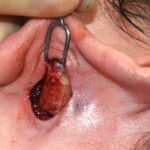
Under local anesthesia, the holes and the excess tissue that hung down was excised. It is necessary to remove all skin that lines the enlarged hole edges. V-shaped skin flaps are designed and put together along the helical rim to prevent notching as it heals. Because he lived out of town and could not return for suture removal, it was closed with dissolveable sutures and topical glue for a dressing.

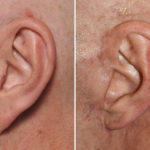
He went on heal without any problems and the earlobe scar was fairly indiscernbible. His case illustrates that reconstruction of the ‘gauged’ earlobe is simple and very effective. A normal earlobe size and shape can be obtained. The need for such earlobe reconstruction is increasing as some people decide to move on from this fashion trend or its correction is required by their potential employers or on entering military service.

Case Highlights:

1) Large amounts of gauging or internal expansion of the earlobe will not shrink completely back down. Ideally, one should allow six months to see how the hole will ‘close’ and have the earlobe tissues return to a more normal consistency.

2) One favorable benefit of the enlarged earlobe is that there is a surplus of earlobe tissue to work with during the reconstruction. This makes for a very favorable reconstruction situation.

3) Reconstruction of the gauged earlobe can be done under local anesthesia without any real recovery. It will result in a fine line scar down through the middle of the reshaped earlobe.

Dr. Barry Eppley

www.eppleyplasticsurgery.com

Indianapolis Indiana

Earlobe Reconstruction of the Gauged (Expanded) Earlobe

Sunday, May 31st, 2009

Earlobe repairs are often quite simple and use standard techniques for slits and tear deformities. The gauged ear, however, is a different matter.  Gauges, also known as tunnels, cogs, caps or plugs, create a considerable tissue expansion of the earlobe and require a more sophisticated approach to repair.

Younger men with gauged ears are increasingly requesting earlobe repair. This is usually so that they can enroll in the military. If not for this concern, many simply remove the earlobe device and let it shrink and contract with a resulting earlobe deformity.

Like a simple split earlobe repair, gauged ear reconstruction can be done under local anesthesia. In simplicity, the oval cleft of the earlobe is initially converted into a complete cleft by removing the remaining skin margins up to the diameter of the gauged device. The remaining inner earlobe margins (which were up against the device) are de-epithelized. The reapproximation process of the edges then begins at the apex of the cleft margins and runs outward towards the helical margin. By so doing, one can work out any excess vertical length so the repair does not look too long and pointy. A two-layer closure is done at the subcutaneous and skin layers. I prefer skin sutures that have to be removed in 7 to 10 days. No dressing is needed.

In significant ear gauges, a completely normal earlobe may not be possible to get. Usually the earlobe will be a little smaller. But I prefer a well-shaped earlobe that is smaller than one that is more normal in size but has an elongated appearance.

Dr. Barry Eppley

http://www.eppleyplasticsurgery.com

http://www.ologyspa.com

Clarian North Medical Center, Carmel, Indiana

Clarian West Medical Center, Avon, Indiana

Indianapolis

Earlobe Enhancement with Injectable Fillers

Tuesday, May 27th, 2008

It is a well recognized phenomenon that as we age, our earlobes sag and ‘grow’ longer. With this sagging, some earlobes get thinner and develop creases or wrinkles as well. This is almost an exclusive female problem which is often exaggerated by the use of ear rings over the years. In those women who develop elongated ear lobe holes or have actual tears, resulting in a split ear lobe, the ear lobes are often thin as well even after surgical repair.

 
One of the more uncommon, but very beneficial uses of injectable fillers, is to rejuvenate the appearance of the thinned ear lobe. Adding volume to the ear lobe through an injectable filler helps expand and stretch the ear lobe out to a more youthful appearance. I prefer the use of a hyaluronic filler, such as Juvaderm, Restylane, or Perlane, to create this tissue-expanding earlobe effect. It is quick and easy to perform and a hyaluronic filler flows in quite nicely into the small space of the earlobe. A small volume of .2 to .3ccs is all that is needed per ear alobe. An injectable filler in the ear lobe seems to last much longer than in any other area of the face, presumably due to the lack of any muscle movement on the treated area. patients can wear ear rings immediately thereafter.

 
I would not say that the hyaluronic acid fillers in the ear lobe are permanent but volume retention up to a year is likely. I suspect that any of the particulated fillers would last much longer (years) and I will likely turn to using those instead in the near future. I don’t think they pose any increased risk in the ear lobe compared to any other facial area.

 
For those squeemish about putting a needle in the ear (I would be!), I always numb up the area first by doing a simple injection of local anesthetic right in front of the earlobe which is not as tender an area. Ear lobe injections are then painless!

 
Dr. Barry Eppley
http://www.eppleyplasticsurgery.com
http://www.ologyspa.com
Clarian North Medical Center, Carmel, Indiana
Clarian West Medical Center, Avon, Indiana
Indianapolis

Reconstruction of the Stretched Earlobe (Gauged Ear)

Tuesday, May 13th, 2008

While the wearing of earrings for both women and men has a long history, the more recent phenomenon of stretching the earlobe with plug inserts is more recent. This current ear adornment statement is often referred to as gauging, although the more accurate term would be stretching.


From a plastic surgery standpoint, this is really tissue expansion of the earlobe. It is a different twist on our concept of tissue expansion in that it is done as an external method of tissue expansion as opposed to what we do in plastic surgery which is internal. (e.g., tissue expansion for breast reconstruction)

 
From a cultural and aesthetic standpoint, I can not comment on this current practice. To each his own so to speak. From a plastic surgery standpoint, however, I must say that it may have very negative long-term effects on the earlobe. This is not like wearing a piercing and simply removing it later with the tradeoff of a near negligible hole(s). This practice creates permanent damage to the earlobe by altering its shape, the quality of earlobe left, and the real possibility of significant scarring, even keloids. I am now getting request and seeing patients who want their ‘gauged’ earlobes reconstructed.
As you might imagine, there is a great diversity to the type of earlobe problems that stretching/gauging can cause. I have seen relatively small holes that have shrink back down to a patient with large keloid formation. In every case, however, the earlobe tissue is not really normal and can either be quite thin or thick and scarred. Just as the practice of earlobe stretching is variably done, the resultant problems if they occur are also quite diverse.

 
The reconstruction of the stretched earlobe, fortunately, is not as difficult as patient who has no earlobe. Having cut my teeth on ear reconstruction in the microtia patient, it is always better to have something to work with, even if it is not completely normal. Usually the stretched earlobe hole is opened up and the two bivalved earlobe remnants brought back together in a near straight line fashion. This is a simple procedure that can be done in the office under local anesthesia. Sometimes I will place a small V or Z at the rim of the earlobe in an attempt to avoid notching as it scars down and heals. This procedure will, in many cases, result in an earlobe that is smaller than what one had prior to the stretching experience.

 
I have had only one experience so far with true keloid formation from earlobe stretching. Keloids anywhere are very prone to recurrence and may eventually require steroid injections or even radiation in addition to surgical excision and reconstruction. Many times, even with everything we know how to do, keloids still recur. I have seen this occur even from simple earlobe piercings so I am certain stretching the earlobe will cause as many, if not more, of this problem.

 
While I can not condone the potentially deleterious practice of earlobe stretching, earlobe reconstruction can always be done and most patients will have a reasonable outcome.

 
Dr. Barry Eppley
http://www.eppleyplasticsurgery.ocom
http://www.ologyspa.com
Clarian North Medical Center, Carmel, Indiana
Clarian West Medical Center, Avon, Indiana
Indianapolis


Dr. Barry EppleyDr. Barry Eppley

Dr. Barry Eppley is an extensively trained plastic and cosmetic surgeon with more than 20 years of surgical experience. He is both a licensed physician and dentist as well as double board-certified in both Plastic and Reconstructive Surgery and Oral and Maxillofacial Surgery. This training allows him to perform the most complex surgical procedures from cosmetic changes to the face and body to craniofacial surgery. Dr. Eppley has made extensive contributions to plastic surgery starting with the development of several advanced surgical techniques. He is a revered author, lecturer and educator in the field of plastic and cosmetic surgery.

Read More


Free Plastic Surgery Consultation

*required fields


Pricing

The cost of any type of elective plastic surgery plays a major role in the decision to undergo the procedure(s).

More Info


Military Discount

We offer discounts on plastic surgery to our United States Armed Forces.

More Info


Categories