Explore the World of Cosmetic Plastic Surgery, Medical Spa, and Skin Care from Indianapolis Plastic Surgeon, Dr Barry Eppley

Archive: laser resurfacing

The Top Ten Instructions After Facial Laser Resurfacing
Posted on 20 August 2008 | Category: laser resurfacing, postoperative instructions

Resurfacing of damaged and wrinkled skin by the laser is a very effective procedure for creating smoother skin with a better texture. Because laser resurfacing is really a big burn and it is on your face, the after care is both significant and a little laborious. Not to mention somewhat psychologically disturbing as you see your face during the first week after treatment. The degree of care needed is dependent on the depth of the laser resurfacing. In general, if the procedure was done in the operating room under some form of anesthesia then it is likely is was DEEP laser resurfacing and the following list of instructions apply. In office-based laser resurfacing, this is either light or medium depth levels and the healing is much faster without the need for extensive after care.
1) Keep all treated areas covered with Aquaphor ointment constantly. Clean the
facial wounds gently with Cetaphil soap and cool water every 6 hours or so
the first two days and then twice a day thereafter.
2)Aquaphor ointment should be applied liberally to keep the treated areas moist.
T he formation of scabs is not desired. If they appear, it is because either not enough ointment is
being applied or it is not being applied frequently enough. If scabs do appear, do not scrub, pick,
or rub off any of them.
3) The more fluids you drink, the better your skin will heal. Try to drink 8 - 10
ounces of fluid every 2 to 3 hours during the first week after surgery.
4) You should continue oral antibiotics (e.g., Kelfex) for 7 days after surgery.
5) If the area around the mouth was treated, you should continue antiviral
medication (e.g., acyvlovir) for 5 days after surgery.
6) Take your pain pills (e.g., Vicodin) as prescribed.
7) You may experience mild itching 3 to 7 days after surgery. Ice packs gently
applied on top of the treated areas during the first day or two after surgery will
alleviate most itching. For more severe itching, you may try over-the-counter
Benadryl 30mg every 6 hours. (this will make you sleepy so no driving)
8) Once the skin is healed (7 - 8 days), apply your regular moisturizer to the
the treated areas liberally for the next few weeks to keep it from getting dry.
9) NO make-up until 7 - 10 days after surgery. A mineral-base foundation is
is recommened to both conceal the redness and sensitivity of the skin in the
first month.
10) Avoid direct sunlight during the first month after surgery. The skin is very
sensitive during this early healing phase. After the first week after surgery, wear
sunprotection (SPF 30 or higher) for the next 3 months when going to be exposed
to the sunlight.
Dr. Barry Eppley
http://www.eppleyplasticsurgery.com
http://www.ologyspa.com
Clarian North Medical Center, Carmel, Indiana
Clarian West Medical Center, Avon, Indiana
Indianapolis

Comments Off | Comments Off

The Treatment of Lip Wrinkles
Posted on 16 June 2008 | Category: Botox, fractional laser resurfacing, injectable fillers, laser resurfacing, laserbrasion, lip lines, lip wrinkles

I read a recent article that reports that drinking directly from water bottles can cause just as many upper lip wrinkles as smoking. I wouldn’t doubt it as any activity that makes your lips pucker, which activates the orbicularis oris muscle which encircles the mouth, can cause wrinkles to appear on the upper lip. The development of such wrinkles is a function of both the activity and how often it is done. Drinking water these days for some people is about as frequent as a regular smoker who does one or two packs per day.
As a general principle, wrinkles form on the face perpendicular to the direction of action of the underlying muscle movement. For example, horizontal forehead wrinkles are the result of ther vertically-oriented and moving frontalis muscle which extends from the brows upward into the scalp. Since the mouth’s main muscle (like the eyes) is a sphincter or encircling muscle which lies parallel (horizontal) to the upper and lower lip (except at the corners), it is no surprise that the lips (particularly the upper) develops vertical wrinkles in some people. The other factor that highly contributes to lip wrinkles is the thickness of your skin and the size of your lips. (which is interrelated) The thicker your skin, the less likely you will ever develop them. Take a look at African-Americans and people of Middle Eastern Descent, you rarely ever see them develop wrinkling of the lips. (and they have larger lips to begin with….as their skin is thicker)
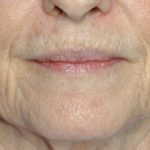
Treatment of lip wrinkles is a challenging problem. I tell patients to think of it as improvement as there is no complete cure in most cases. For small and fine lines that are mainly located at the junction of the skin and the lip, an injectable filler can make a nice improvement…if you can accept having slightly to substantially larger lips. (whichever you desire) When the lip wrinkles are deeper and run higher into the upper lip, the concept of skin resurfacing comes into play. Usually this means laser resurfacing and it is just a question of how deep to go and how much recovery does the patient want. Laser resurfacing with lip augmentation with an injectable filler is the most common method by which I treat more significant lip wrinkling issues. This is done in the office under local anesthesia unless the patient is having other facial procedures which requires a trip to the operating room with the use of deeper anesthesia. There is some current debate between the laser techniques of resurfacing or peeling and the use of fractional (fraxel) laser treatments, but there is no hard clinical evidence at this point to say conclusively that fractional laser treatments are better. In the more severe cases, a small amount of Botox to help reduce the amount of muscle movement can also be helpful when done with fillers or laser resurfacing but you must be careful to not use to much lest you make your smile have an unnatural appearance.
Other methods of upper lip resurfacing for lip wrinkles is currently being evaluated. One method is to combine laser resurfacing with the use of sandpaper (yes I said sandpaper), known as laserbrasion. With this technique, the laser is only used for the first pass (to remove the very top layer of skin) and the deeper layers are then taken done by fine sandpaper. The concept here is that the use of sandpaper causes less trauma (no heat) and will heal faster without the prolonged redness. And it is just as effective as the laser but safer and with less complications than if one used traditional dermabrasion. The other method is known as percutaneous collagen induction therapy. (PCIT) Known aerating your lawn, a small wheel with fine needles is run over the upper lip, cutting many fine holes into the deeper portions of the skin. As this heals it causes the skin to thicken which helps reduce the amount of visible wrinkling.
Upper lip wrinkles in some women are unavoidable and can be very troubling. Injectable lip fillers, laser resurfacing, abd Botox can help but there is no permanent cure. The alternative treatments of fractional laser treatments, laserbrasion, and collagen induction therapy are interesting but it is too early to know if they will offer better results.
Dr. Barry Eppley
http://www.eppleyplasticsurgery.com/
http://www.ologyspa.com/
Clarian North Medical Center, Carmel, Indiana
Clarian West Medical Center, Avon, Indiana
Indianapolis

Getting Rid Of Those Crow’s Feet
Posted on 03 June 2008 | Category: Botox, crow's feet, laser resurfacing

Lines around the eyes give a variety of emotional expressions, most of which convey a negative impression. These periocular lines, or crow’s feet as they are commonly referred to, are the result of normal but excessive muscle action of the underlying orbicularis oculi or sphincter muscle of the eye. As wrinkle lines form perpendicular to the action of the encircling muscle around the eye, wrinkles develop and radiate outward in a ’sunray’ effect. Elimination or softening of these lines is a frequently requested procedure. While this request is simple, adequately treating crow’s feet often requires combination therapy.
Botox remains as the primary treatment method for the crow’s feet area. Trying to remove these wrinkles without reducing their muscular action will produce disappointing results. Three injections sites for each side will usually suffice, placing them along the lateral orbital rim from below the eyebrow to the body of the zygoma. I never inject below the zygoma for fear of causing paralysis of the upper lip. Most patient’s will have a large vein or two in this area so it is important to avoid these and stay further temporally if necessay, otherwise a nice large bruise will result which will take weeks to go away. A total of 10 to 12 units of Botox per side is usually an adequate dose. For the younger patient without established crow’s feet wrinkles, the use of Botox will be completely preventative if treatments are maintained.
For the older patient who at rest already has established crow’s feet wrinkles, combination therapy will be needed. Botox in combination with laser resurfacing can produce some really significant results. Since the eyelids and the surrounding skin is quite thin, it is an area that is particularly reponsive to laser resurfacing. For most patients that have a treatment focused on the crow’s feet area alone, we are not talking about deep laser surfacing. Rather I use a light to moderate depth laser resurfacing so that healing occurs quite quickly, usually within three to five days. Laser depths around 35 to 50 microns (deep laser resurfacing is around 200 - 300 microns) are easily tolerated in the office under topical anesthetic cream, are quick to perform, and require minimal post-treatment care. The crow’s feet area is pre-treated with Botox during the same visit and then laser resurfaced. To keep the recovery quick, the depth of laser penetration is keep limited. Think about a series of these treatments done twice a year to eventually get the best result.
Botox and light laser resurfacing are the principal methods of treatment for crow’s feet. Botox alone is a great treatment for young patients given its prophylactic effects. When laser resurfacing of the crow’s feet skin is needed, a good long-term result is only possible if the underlying muscle action is controlled.
Dr. Barry Eppley
http://www.eppleyplasticsurgery.com
http://www.ologyspa.com
Clarian North Medical Center, Carmel, Indiana
Clarian West Medical Center, Avon, Indiana
Indianapolis

Those Difficult Upper Lip Lines
Posted on 14 March 2008 | Category: Botox, dermabraasion, injectable fillers, laser resurfacing, lip lines

One of the features of facial aging that bothers women the most is the development of upper lip lines. Whether they be small fine lines that are at the junction of the skin and upper lip or much deeper lines that extend vertically way up into the skin…women hate them…as they indicate a more aged mouth look and in more severe cases allows lipstick to bleed up into the lines. Many patients think it is due to smoking and chronic sun exposure (and clearly these can make a big contribution) but the reality is…it is a function of full your lips are and how thick your skin is. This is why this is much more of a problem in Caucasians of northern European and English descent than it ever is in African-Americans, southern Europeans, or those of Mediterranean origins. As all natural wrinkles form perpendicular to the direction and action of the underlying muscles, vertical lip lines develop from the action of the circumferential orbicularis muscle that purses your mouth around a straw, cigarette, or puckers ofr that kiss.
While the diagnosis of this problem is easy, it’s treatment is not. Since you can’t cure the cuse of the lines (thicken your skin or stop moving your mouth), I tell patients to think about improvement (but not elimination of the upper lip lines) and the need for maintenance treatments as we are not curing the root of the problem. Treatment choices are based on three achievable objectives; diminish the muscle movement (Botox), plump up the lips ir fill the lip lines (injectable fillers), or ’sand’ down the wrinkles. (dermabrasion or laser resurfacing). Any combination of two or more of these will produce a better result in most patients. While Botox can certainly weaken the muscle movement and cause less puckering, it must be done carefully so as not to create an unnatural lip movement with smiling. For this reason, this is usually the last procedure I will do or will do it only in combination with everything else in the most severe cases. Injectable fillers are a good option if the patient can accept or wants a larger lip. If not, then dermabrasion or medium-depth laser resurfacing is the only other option. The best results that I usually see is when the upper lip is slightly enhanced with a filler and the upper lip is then laser resurfaced at a depth of 50 - 100 microns. This is probably the best combination if, again, the patient can accept a larger upper lip. It heals within a week and can be done in the office under local anesthesia. Patients will usually have to repeat the procedure once a year for maintenance of good results. However, it is fair to say that upper lip lines defy one single permanent solution.
Dr Barry Eppley
http://www.eppleyplasticsurgery.com
http://www.ologyspa.com
Clarian North Medical Center, Carmel, Indiana
Clarian West Medical Center, Avon, Indiana
Indianapolis

Facial Laser Resurfacing - Deep or Superficial ?
Posted on 06 March 2008 | Category: laser resurfacing, skin tightening, wrinkle reduction

When facial laser resurfacing was first introduced over 10 years, the carbon dioxide lasers emitted precise levels of high energy for skin ablation. This resulted in a bloodless form of skin retexturing that had advantages over traditional demabrasion and chemical peels. Due to long recoveries with deep laser resurfacing, however, the current trend is the use of lower energy lasers that do not penetrate as deep, can be done without general anesthesia, and have quicker recovery times. While this approach to laser skin ablation will likely remain into the foreseeable future, the long-term effects of deeper laser resurfacing can not withstand scrutiny.
In the March 2008 issue of Plastic and Reconstructive Surgery, this very issue from a group in Chile was evaluated. They looked at long-term photographic results from 46 patients at 1, 5, and 10 year follow-ups. Their results showed that early results of skin texture was quite good. After 1 year, however, they were able to detect lines of demarcation between treated and non-treated skin and some skin had persistent redness. After 5 and 10 years, advantages were maintenance of good skin texture, elimination of fine wrinkles, and long-term correction of skin pigmenttaion. Some disadvantages included permanent hypopigmentation at the jaw-neck transition, skin telangectasias, and possible accentuation of skin redundancy.
This study supports what we have known for some time. Deep carbon laser resurfacing does an excellent job of removing many fine lines and wrinkles and this effect is maintained for some time. However, it does thin out the skin in some areas which is reflected in the development of telangectasias in the thinned skin. The line of demarcation between treated skin at the neck line is a well-known phenomenon. In other words, there are tradeoffs for wrinkle elimination and skin texture improvement….thinner skin with less pigment is some areas. These long-term effects support exactly why more superficial laser treatments are better. It may take more laser treatments to get similar effects but the results are more physiologic and natural.
Dr Barry Eppley
http://www.eppleyplasticsurgery.com
htp://www.ologyspa.com
Clarian North Medical Center, Carmel, ,Indiana
Clarian West Medical Center, Avon, Indiana
Indianapolis

What’s New in Medical Skin Care? Fractional Laser Resurfacing
Posted on 27 January 2008 | Category: fractional laser resurfacing, laser resurfacing, medical skin care

WHAT NEW IN MEDICAL SKIN CARE: Fractional Laser Resurfacing

I frequently get asked what is the new in the world of medical skin care by my patients as well as others. As I think back over 2007, I have put into my practice the following anti-aging medical treatments which I feel are quite promising.

The removal of an outer facal skin layer to improve its tecture is a concept that has been around for decades. Historically, this has included chemical peels and, in the past decade, laser resurfacing. Laser resurfacing essentially ‘burns’ off a top layer (the depths can be very varied from 6 microns to hundreds of microns) and allows new skin (epithelium) to heal over it, removing some imperfections and improving the texture of the skin. Recovery from laser resurfacing varies by the depth to which it is done, a 10 micron laser peel may be a few days, a 100 micron laser peel will be 7 to 10 days. The depth issue aside, laser resurfacing always involves some recovery (as it is a burn) and it only treats the outer layers of the skin.

Fractional CO2 laser resurfacing takes a conceptually different approach. Rather than ‘burning’ 100% of the skin’s surface that it hits, it only treats or penetrates a ‘fraction’ of it. For every area treated, it may only actually hit 10 - 20% of the skin area. Hence, a fractional treatment approach. But equally importantly, the laser penetrates much deeper (hundreds of microns) into the skin, actually stimulating the deepest part of the skin layers. (think of it as boring holes much like you do to your lawn to allow nutrients to get ‘to the roots’ so to speak) Because only a fraction of the skin is treated, there is less recovery than with traditional laser resurfacing even though the depth of laser penetration is much deeper. Also because it is fractional, it requires a series of treatment, at least five, to effectively get all of the skin’s surface treated. In theory, there is more of an anti-aging effect (due to the deeper penetration) but less recovery due to less skin being injured at any one time.

Fractional laser resurfacing of facial skin is being currently touted as being better than traditional laser resurfacing. The evidence to support that claim, to date, is still conclusively lacking. Plus, I am not sure how the laser knows during sequential treatments to hit previous skin areas that have yet to be treated. (of course, it cannot know, so some skin areas undoubtably get treated more than once and some probably are missed altogether as we are talking about fractions of millimeters here) For this reason, it probably take 6 or 7 treatments to truly treat all facial skin areas in the laser’s target. Despite these reservations, fractional laser resurfacing remains appealing and more time will tell exactly what its role in medical skin resurfacing actually is.

Dr Barry Eppley
http://www.eppleyplasticsurgery.com
http://www.ologyspa.com
Clarian North Medical Center, Carmel, Indiana
Clarian West Medical Center, Avon, Indiana
Indianapolis

Upper Lip Lines - Difficult Problem, Multiple Solutions
Posted on 31 October 2007 | Category: injectable fillers, laser resurfacing, medical needling

Upper Lip Lines – A Not So Simple Problem

One of the seemingly ‘simple’ but most difficult cosmetic facial problems that I see in my practice is the woman with upper lip lines. Like dark spots on the hands, these telltale signs of aging are very disturbing for the aging woman. Ironically, I have seen them even in some younger patients, so it is not always a sign of aging! While frequently thought of as being due to smoking or excessive sun exposure (and these certainly are important contributing factors), it is as much due to the native thickness of one’s skin (racial type) as well as how one moves their face with expressions than anything else. These can be easily shown by looking at African-Americans, Hispanics, and people of Middle Eastern or Pacific Rim descent who have much thicker skin (more dermis and elastin fibers), it is very rare to ever seen upper lip lines in these ethnicities. So, in many ways, this is a more significant problem in fair-skinned people of northern European descent, particularly in blondes and redheads.

The two basic treatment approaches are injectable fillers (JuvaDerm or Radiesse) placed directly into the vertical lip lines or laser skin resurfacing. Often I will do both together, at the same time, to get the best result. These are simple office procedures that are done under a local anesthetic to numb the whole upper lip through traditional dental block techniques. Neither of these approaches ‘cures’ the problem, but significant improvements can be obtained. To maintain the result, it is usually necessary to have the treatments twice a year.

An interesting ‘new’ treatment approach is that of medical needling. This is actually an old technique that may be coming back into popularity. Essentially, a roller with many fine needles is run over the upper lip (like aerating your lawn), creating fine tunnels into the deep part of the skin. Topical vitamin C preparations are then applied after so that they may ‘soak’ into the tunnels and stimulate the underside of the skin, causing it to thicken. So rather than burning the top layer of skin off (laser resurfacing) to soften the wrinkles, this approach focuses on stimulating the skin to thicken. It is being called Transdermal Collagen Stimulation therapy. Whether this is better than fillers or laser resurfacing remains to be seen, but I will be able to have a better idea in another year or so after treating and following some patients.

Dr Barry Eppley
www.eppleyplasticsurgery.com
www.ologyspa.com
Clarian North Medical Center, Carmel, Indiana
Clarian West Medical Center, Avon, Indiana
Indianapolis

Categories

This is a list of the categories. Every post is categorized by the author to help you find what you need.

Archives

This is a list of the monthly archives. Click on the appropriate month to see the historical posts.

Links

This is a list of the links to related resources and websites. Use this list if you'd like to do some additional, relevant reading.